
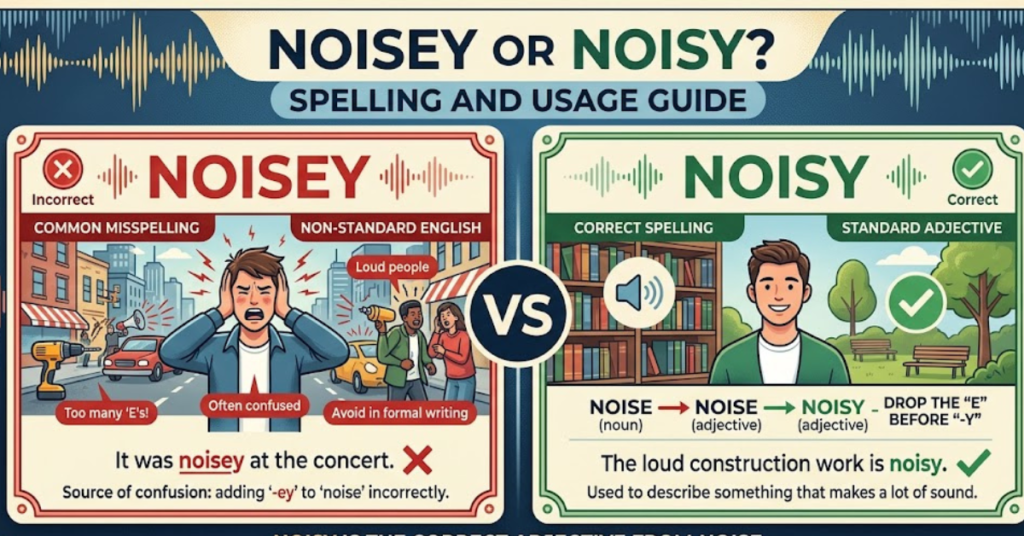

Ever typed noisey and wondered if it looked a bit off? You’re not alone. The confusion between noisey or noisy is surprisingly common, especially since English spelling doesn’t always follow clear rules.
In this guide, we’ll break down the correct spelling, explain why the mistake happens, and show you how to use the word confidently in everyday writing. By the end, you’ll never second-guess it again.
What Does “Noisey or Noisy” Mean?
Let’s clear things up right away: only one of these is correct.
The Correct Spelling: Noisy
Noisy is the correct word. It means:
- Making a lot of sound
- Loud or disruptive
- Full of noise
Examples:
- The street was noisy at night.
- The children became noisy during recess.
The Incorrect Spelling: Noisey
Noisey is not a standard English word. It’s a common misspelling of noisy and should be avoided in formal and informal writing.
Why Do People Confuse Noisey or Noisy?
English spelling can be tricky, and this confusion has a few simple explanations.
Common Reasons
- Words like grey and ey endings influence spelling habits
- Pronunciation makes both versions sound similar
- Lack of familiarity with spelling rules
Because of these factors, many people assume noisey follows a similar pattern—but it doesn’t.
How to Remember the Correct Spelling
If you struggle with noisey or noisy, here are some easy ways to remember the right form.
Simple Tricks
- Think of the base word: noise → noisy
- Replace the “e” with “y,” not “ey”
- Say it mentally as noi-see, not noi-say
Quick Rule
When a word ends in -e, you often drop the “e” and add “y.”
- Noise → Noisy
Examples of “Noisy” in Sentences
Seeing the word in action helps reinforce the correct usage.
Everyday Examples
- The classroom became noisy after lunch.
- The engine sounded noisy and needed repair.
- It’s too noisy to concentrate here.
Descriptive Usage
- A noisy crowd filled the stadium.
- The café was warm but slightly noisy.
Related Words and Synonyms
Understanding similar words can help you use noisy more naturally.
Synonyms for Noisy
- Loud
- Boisterous
- Rowdy
- Clamorous
Opposites
- Quiet
- Silent
- Calm
Common Mistakes to Avoid
Even simple spelling errors can affect clarity and credibility.
1. Writing “Noisey” in Formal Content
Incorrect:
- The room was noisey
Correct:
- The room was noisy
2. Assuming Both Spellings Are Acceptable
Only noisy is correct in standard English.
3. Ignoring Spell Check Warnings
Most tools will flag noisey—don’t ignore it.
When to Use “Noisy” Correctly
You can use noisy in many everyday situations.
Common Contexts
- Describing environments
- Talking about people or behavior
- Referring to machines or traffic
Example Situations
- A noisy neighborhood
- A noisy group of friends
- A noisy air conditioner
FAQs
Is it noisey or noisy?
The correct spelling is noisy. Noisey is incorrect.
Why do people write noisey instead of noisy?
It’s usually due to pronunciation confusion or influence from other “-ey” words.
Is noisey ever correct?
No, noisey is not recognized as a correct spelling in standard English.
What does noisy mean?
It means making a lot of sound or being loud and disruptive.
How can I remember the correct spelling?
Think of the base word noise and simply add “y” to form noisy.
Conclusion
When it comes to noisey or noisy, the answer is simple: noisy is the only correct spelling. While the mistake is common, it’s easy to fix once you understand the pattern behind it.
Stick to the rule of dropping the “e” and adding “y,” and you’ll get it right every time. Small spelling improvements like this can make your writing clearer, more professional, and more confident.
If you found this helpful, consider exploring other commonly confused words to sharpen your language skills even further.