
If you’ve come across the phrase kurt or curt, you might be wondering whether both words are correct or if one of them is just a spelling mistake. It’s a common confusion, especially because the words sound similar when spoken.
The truth is simple: only one of these words is correct in standard English, and it carries a very specific meaning.
Let’s clear it up in a way that’s easy to remember.
Is It Kurt or Curt?
The correct word is:
- Curt
“Kurt” is not the correct spelling in this context when describing behavior or tone.
So if you’re asking is it kurt or curt, the correct answer is always “curt.”
Kurt or Curt Meaning Explained
To understand kurt or curt meaning, we need to look at what “curt” actually means.
Curt means:
- Short or brief in speech or reply
- Rudely abrupt or blunt
- Not showing much emotion or friendliness
Example sentences:
- “His curt reply made the conversation uncomfortable.”
- “She gave a curt answer and walked away.”
- “The manager was curt with the staff.”
So, “curt” usually describes communication that feels short or slightly rude.
Why People Confuse Kurt or Curt
The confusion between these words often comes from pronunciation.
Common reasons include:
- Both words sound similar in speech
- “Kurt” is a common name in some countries
- Spelling mistakes in fast typing
- Lack of familiarity with the word “curt”
But in grammar and vocabulary, only “curt” is correct for describing tone or behavior.
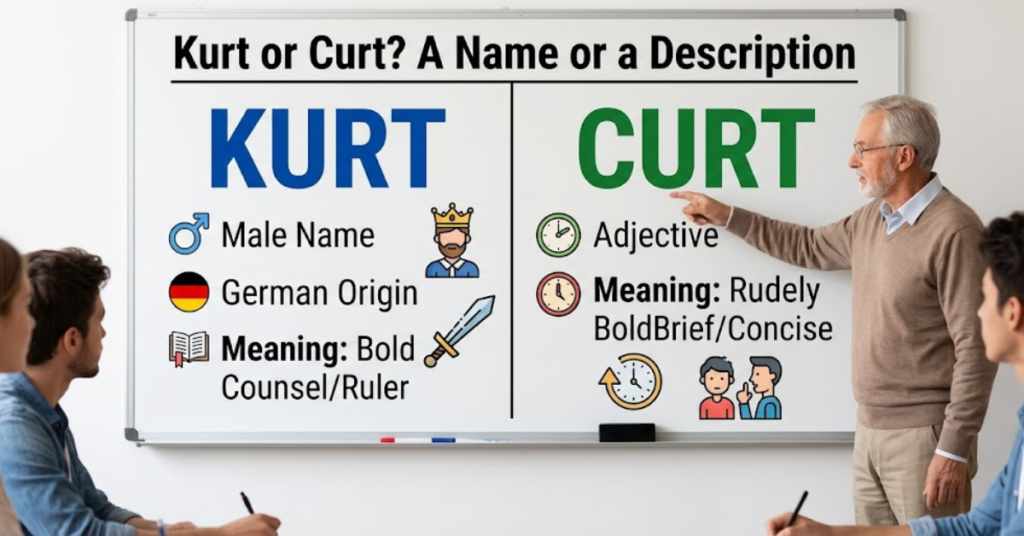
Is Kurt or Curt a Name or a Word?
Here’s where things get interesting.
Kurt:
- A proper name (common in Germanic languages)
- Example: Kurt is a person’s name
Curt:
- An adjective in English
- Used to describe speech or behavior
So when comparing these words, they are completely different in meaning and usage.
Curt in Everyday English Usage
The word “curt” is often used in formal and informal writing to describe communication style.
Common uses:
- Curt response
- Curt tone
- Curt reply
Example situations:
- A teacher answering briefly without detail
- A boss speaking sharply under stress
- A person replying without emotion
In all these cases, “curt” reflects shortness or lack of warmth.
Kurt or Curt in Grammar Context
From a grammar perspective:
- “Curt” is an adjective
- It modifies nouns like “reply,” “tone,” or “response”
Example breakdown:
- Curt + reply = short or rude reply
- Curt + tone = sharp tone
So in correct English usage, kurt or curt always resolves to “curt.”
How to Remember the Correct Word
Here’s a simple trick:
- Curt = “cut short” in communication
- Think of it as cutting a sentence short
This helps you avoid confusion when deciding between these words.
Common Mistakes with Kurt or Curt
People often make errors like:
- Thinking both are interchangeable
- Mishearing the word in conversations
- Relying on autocorrect suggestions
But in formal English writing, only “curt” is acceptable.
Curt vs Polite Communication
To better understand the meaning, compare curt communication with polite speech:
Curt:
- “No.”
- “I’m busy.”
- “Not now.”
Polite:
- “No, thank you.”
- “I’m a bit busy right now.”
- “Maybe later.”
This shows how “curt” often lacks extra words or politeness markers.
FAQs About Kurt or Curt
Is it kurt or curt?
The correct word is “curt.”
What does curt mean in English?
It means short, brief, or slightly rude in speech or behavior.
Is kurt a real English word?
“Kurt” is usually a name, not an adjective.
Why do people write kurt instead of curt?
It is often due to spelling mistakes or confusion in pronunciation.
Can curt be polite?
No, curt usually implies a lack of politeness or warmth.
How do you use curt in a sentence?
Example: “He gave a curt reply and left the room.”
Conclusion
The confusion between kurt or curt is common, but the answer is clear: “curt” is the correct English word used to describe short or blunt communication. “Kurt,” on the other hand, is typically a personal name and not used in this context.
Once you understand the meaning and usage of “curt,” it becomes easy to avoid mistakes and use the word correctly in writing and conversation.