

If you’ve ever wondered about payed vs paid, you’re not alone. Many English learners and even native speakers get confused by these two words because they look and sound similar. However, only one is commonly correct in modern English.
The short answer is simple:
- paid is correct in most situations
- payed is rarely correct and used only in very specific nautical contexts
Let’s break it down clearly so you always use the right word.
Payed vs Paid Meaning Explained
When comparing payed vs paid meaning, the key difference comes down to usage:
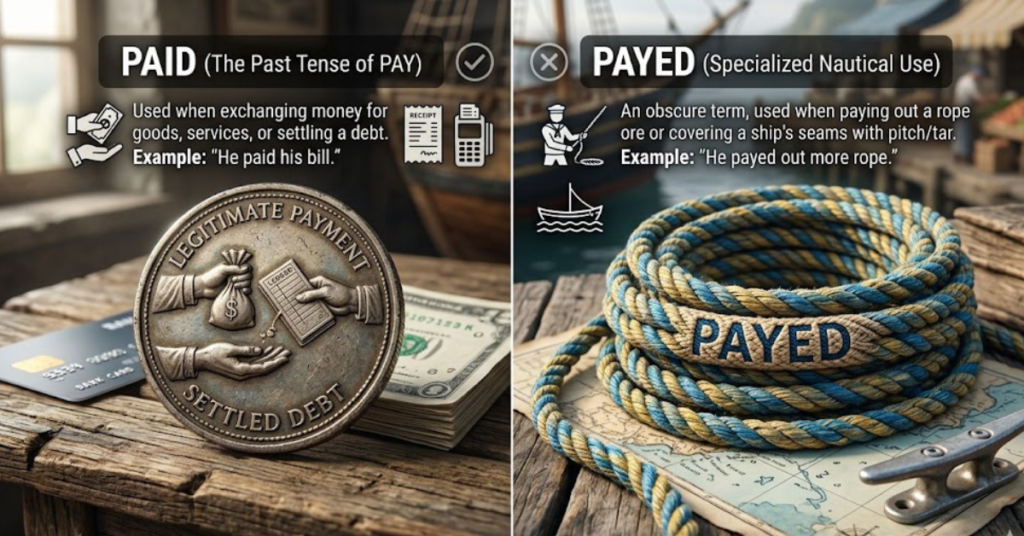
Paid (correct and standard)
“Paid” is the past tense of “pay” in almost all cases.
It means:
- giving money for something
- settling a debt
- completing a financial transaction
Example:
- I paid the bill yesterday.
Payed (rare and specialized)
“Payed” exists, but it is not commonly used in everyday English.
It is mainly used in nautical terms:
- to “pay out” a rope or cable
Example:
- The sailor payed out the anchor rope.
So when people search payed vs paid definition, the important point is:
“paid” is general usage, “payed” is technical and rare.
Payed vs Paid Grammar Difference
The payed vs paid grammar difference is simple:
Paid
- correct past tense of “pay”
- used in financial, emotional, and general contexts
- widely accepted in all English varieties (US, UK, etc.)
Payed
- not used for money
- limited to nautical language
- considered incorrect in most writing
So in modern grammar, paid is always the safe choice.
Payed vs Paid Attention
One of the most common phrases people search is payed vs paid attention.
Correct form:
- I paid attention to the teacher.
Incorrect:
- I payed attention (wrong in standard English)
So the rule is simple:
Always use “paid attention,” never “payed attention.”
Payed vs Paid Money
Another frequent confusion is payed vs paid money.
Correct usage:
- I paid money for the ticket.
- She paid him back yesterday.
Incorrect:
- I payed money (not standard English)
Whenever money is involved, always use:
- paid
Payed vs Paid Off
When using payed vs paid off, the correct form is also:
- paid off (correct)
Examples:
- He paid off his loan.
- She finally paid off her debt.
“Payed off” is not correct in financial contexts.
Payed or Paid Examples in Sentences
Here are clear examples to help you understand payed vs paid examples:
Correct (paid)
- I paid the rent on time.
- She paid for dinner.
- They paid attention in class.
- He paid off his credit card.
Incorrect (payed)
- I payed the rent. (wrong)
- She payed for dinner. (wrong)
Payed or Paid Difference in Simple Terms
The payed vs paid difference can be summarized like this:
- Paid = money, attention, bills, debts (everyday English)
- Payed = nautical term (ropes, cables, ships)
So unless you are talking about sailing, always use paid.
Payed or Paid UK Usage
In payed or paid UK English, the rule is the same as American English:
- “paid” is correct
- “payed” is outdated or technical
Both UK and US grammar rules agree on this usage.
Merriam-Webster Payed or Paid
According to standard dictionary usage (including Merriam-Webster payed vs paid references):
- “paid” is the standard past tense of “pay”
- “payed” is only used in specific nautical meanings
This confirms that “paid” is the correct everyday form.
When to Use Payed or Paid
Here’s a simple rule for when to use payed or paid:
Use “paid” when:
- talking about money
- paying bills or debts
- giving attention
- general everyday situations
Use “payed” only when:
- discussing sailing or nautical ropes
- using technical maritime language
For 99.9% of situations, you should use:
- paid
FAQs
What is the difference between payed or paid?
“Paid” is the correct past tense of pay in most contexts. “Payed” is rare and used only in nautical terms.
Is payed ever correct?
Yes, but only in sailing contexts like “payed out a rope.”
Should I say paid attention or payed attention?
The correct phrase is “paid attention.”
Is it paid money or payed money?
The correct form is “paid money.”
Why do people write payed instead of paid?
It is usually due to confusion or assuming all past tense verbs end with “-ed.”
What is the correct grammar rule for payed or paid?
Use “paid” for standard English. Use “payed” only in specific maritime contexts.
Conclusion
Understanding payed vs paid is actually quite simple once you know the rule. The word “paid” is the correct and widely used past tense of “pay” in everyday English, whether you’re talking about money, attention, or debts. The word “payed” is rare and limited to nautical terminology, making it unsuitable for general use.
If you remember one thing, let it be this:
In almost all situations, “paid” is always the correct choice.