

English spelling can be tricky, especially when two words look or sound somewhat similar but mean completely different things. A common example is threw vs through, which often confuses learners, writers, and even native speakers in fast writing or speech.
Although these words are unrelated in meaning, they are frequently mixed up because of similar pronunciation patterns and typing errors. In this guide, we’ll break everything down in a simple, practical way so you can confidently understand the difference, use each word correctly, and avoid common mistakes in writing and conversation.
Why “Threw” and “Through” Get Confused
The confusion between threw vs through vs thru happens mainly due to spelling similarity and fast pronunciation in spoken English.
Even though they look similar, they belong to completely different grammatical categories:
- One is a verb (action word)
- One is a preposition or adverb (direction or movement)
Another reason for confusion is the informal spelling “thru,” which sometimes appears in texting or signage.
What Does “Threw” Mean?
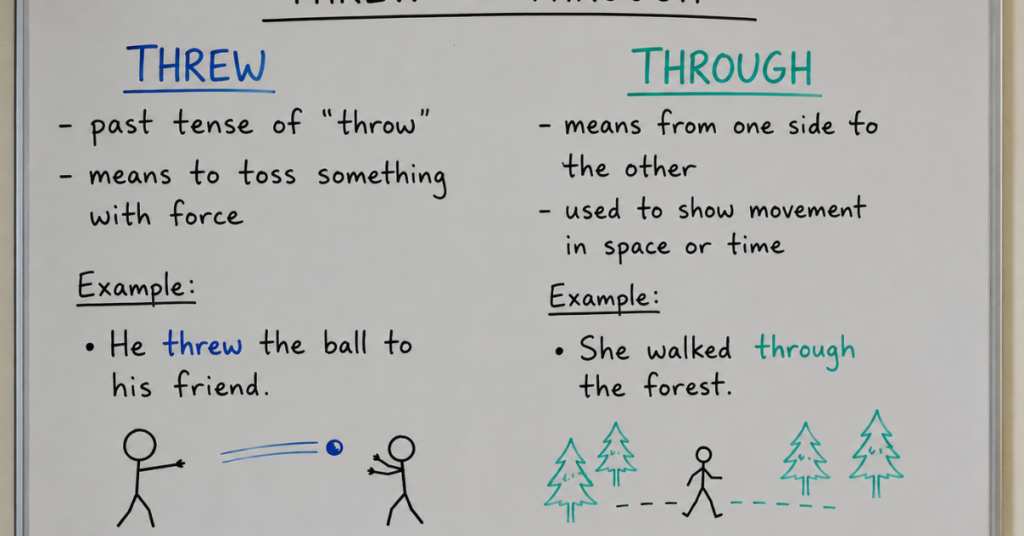
“Threw” is the past tense of the verb “throw.” It refers to the action of tossing or propelling something through the air using force.
Threw Definition Explained
Threw= past action of throwing something
Threw in Sentences
Here are simple threw vs through sentences examples using “threw”:
- He threw the ball across the field.
- She threw her bag on the chair.
- They threw a surprise party for him.
Key Idea of “Threw”
It always involves:
- Physical action
- Movement of an object
- Past tense usage
What Does “Through” Mean?
“Through” is a versatile word used as a preposition, adverb, or adjective. It generally means moving from one side to another, completing something, or being inside something.
Through Definition Explained
Through= movement from one side to the other or completion of an action
Through in Sentences
- We walked through the tunnel.
- She read through the entire book.
- The train went through the city.
Key Idea of “Through”
It is often used for:
- Movement
- Completion
- Passage
- Duration
Threw vs Through Definition in Simple Terms
To clearly understand threw vs through definition:
Threw
- Past tense verb
- Means to toss or hurl something
Through
- Preposition/adverb
- Means movement, completion, or passage
One is an action you perform, the other describes direction or process.
Threw vs Through Pronunciation
Even though they look similar, their pronunciation differs slightly.
Threw
- Pronounced: “throo”
Through
- Pronounced: “throo”
This is why many learners confuse them in speech and spelling. They are homophones in many accents, which makes context essential.
Threw vs Through vs Thru
The variation threw vs through vs thru adds even more confusion.
Thru
- Informal spelling of “through”
- Common in texting, signage, and informal writing
Examples:
- Drive-thru
- Thru lane
- Thru traffic
Important:
“Thru” is not recommended in formal writing.
Thru vs Threw vs Through Explained Simply
To avoid confusion:
- Threw = past action
- Through = movement or completion
- Thru = informal shortcut for “through”
Example comparison:
- He threw the ball through the window.
Here, both words are correct but serve different purposes.
Threw vs Through Examples in Real Life
Seeing threw vs through examples makes the difference clearer.
Examples with “Threw”
- She threw the paper in the bin.
- He threw the keys on the table.
- They threw stones into the river.
Examples with “Through”
- We walked through the forest.
- She worked through the night.
- The road goes through the village.
Threw vs Through Sentences Practice
Here are mixed threw vs through sentences for better understanding:
- He threw the ball through the hoop.
- She threw her coat through the doorway in frustration.
- We moved through the crowd quickly.
- They threw confetti through the air during the celebration.
Notice how both words can appear in the same sentence but have different roles.
Common Mistakes with Threw and Through
Incorrect Usage
- He through the ball at me.
- She threw the tunnel quickly.
Correct Usage
- He threw the ball at me.
- She walked through the tunnel quickly.
Mistakes usually happen because of spelling confusion, not grammar misunderstanding.
Why Context Matters
Context is the only reliable way to distinguish threw vs through.
Ask yourself:
- Is it an action in the past? → Threw
- Is it about movement or passage? → Through
This simple rule works almost every time.
Threw vs Through Worksheets Practice Idea
Teachers often use threw vs through worksheets to help students practice.
Typical worksheet exercises include:
- Fill in the blanks
- Sentence correction
- Matching words with meanings
- Writing original sentences
Example:
- He ___ the ball over the fence. (threw / through)
Answer:
- He threw the ball over the fence.
These exercises help reinforce correct usage through repetition.
Memory Tricks to Remember the Difference
Simple tricks can make learning easier.
Threw = Throw (Past Action)
Think:
- Throw → Threw
Through = Travel Path
Think:
- Through = travel from one side to another
Another trick:
- Threw has “ew” like “throwed action”
- Through has “ough” like “going through something”
FAQs About Threw vs Through
What is the difference between threw and through?
“Threw” is the past tense of throw, while “through” describes movement or completion.
Is through a verb or a preposition?
“Through” is mainly a preposition or adverb, not a verb.
What is the pronunciation of threw vs through?
Both are often pronounced similarly as “throo” in many accents, which causes confusion.
What is the informal spelling of through?
The informal spelling is “thru,” commonly used in signs and texting.
Can threw and through be used in the same sentence?
Yes, for example: He threw the ball through the window.
Conclusion
Understanding threw vs through becomes simple once you focus on meaning rather than spelling. “Threw” always refers to a past action involving throwing something, while “through” describes movement, passage, or completion.
Although they sound similar, their roles in English are completely different. With practice, examples, and context awareness, you can easily avoid confusion and use both words correctly in writing and everyday communication.