
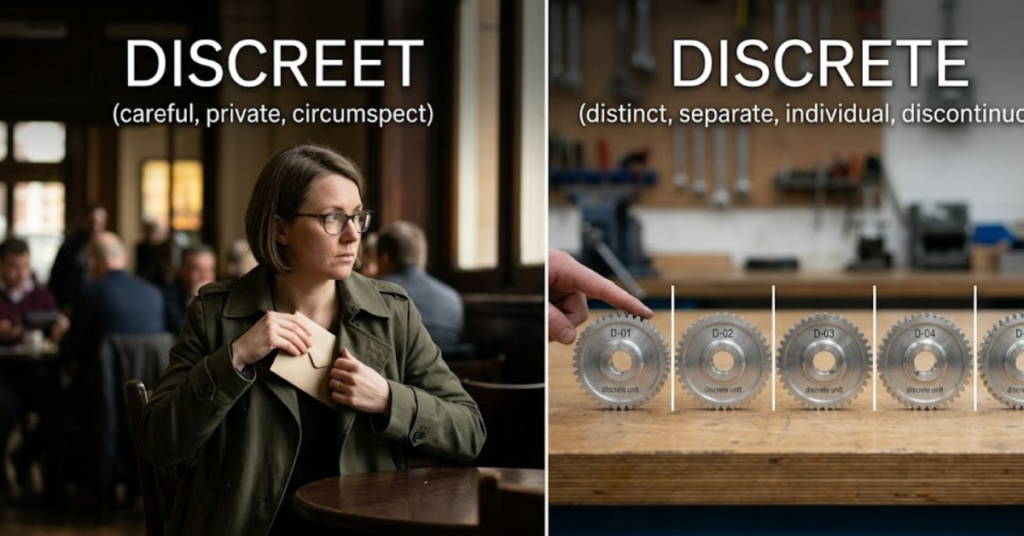

English is filled with words that look nearly identical but have completely different meanings. One of the most commonly confused pairs is discreet vs discrete. The difference may seem small—a single letter change—but using the wrong word can alter the meaning of an entire sentence.
Understanding the discreet vs discrete meaning is essential for students, professionals, writers, and anyone looking to improve their English skills. Although these words share a common origin and sound somewhat similar, they serve very different purposes in modern English.
In this guide, we’ll explore the discreet vs discrete difference, pronunciation, definitions, examples, grammar rules, and practical memory tricks to help you use both words confidently.
Why Are Discreet and Discrete Often Confused?
The confusion surrounding discreet vs discrete comes from several factors:
- Similar spelling
- Similar pronunciation
- Shared Latin roots
- Both function as adjectives
Because only one letter differs between them, many writers accidentally substitute one for the other.
For example:
- She was discreet about the matter.
- The data consists of discrete categories.
Both sentences are correct, but switching the words would completely change their meanings.
Discreet vs Discrete Definition
Before diving deeper, let’s look at the basic definitions.
Define Discreet
Discreet means careful, tactful, prudent, or intentionally unobtrusive.
A discreet person:
- Avoids drawing unnecessary attention
- Exercises good judgment
- Handles sensitive situations carefully
- Respects privacy
Define Discrete
Discrete means separate, distinct, individual, or disconnected from other things.
A discrete item:
- Exists independently
- Is clearly separated from others
- Is distinct or individual
Understanding these core definitions makes the distinction much easier.
Discreet vs Discrete Meaning
The simplest explanation of the discreet vs discrete meaning is this:
Discreet = Careful
Think:
- Tactful
- Private
- Judicious
- Subtle
Example:
- The lawyer remained discreet about the case.
Discrete = Separate
Think:
- Distinct
- Independent
- Individual
- Unconnected
Example:
- The survey data was divided into discrete groups.
This single distinction solves most usage problems.
Discreet vs Discrete Difference
The primary discreet vs discrete difference lies in what each word describes.
Discreet
Describes behavior, actions, or communication.
Examples:
- A discreet conversation
- A discreet inquiry
- A discreet employee
Discrete
Describes objects, categories, units, or concepts.
Examples:
- Discrete variables
- Discrete components
- Discrete sections
A useful shortcut:
Discreet relates to people and behavior.
Discrete relates to things and separation.
Discreet vs Discrete Pronunciation
One reason these words cause confusion is that their pronunciations are very similar.
Discreet Pronunciation
Pronounced:
dih-SKREET
The emphasis falls on the second syllable.
Discrete Pronunciation
Pronounced:
dih-SKREET
In standard English, both words are pronounced virtually the same way.
This makes context especially important when writing.
Discreet vs Discrete Examples
Looking at real-world examples is one of the best ways to understand these words.
Discreet Examples
- The doctor was discreet when discussing the patient’s condition.
- She made a discreet exit from the event.
- The company handled the issue in a discreet manner.
- He asked a discreet question about the negotiations.
Discrete Examples
- The computer system consists of several discrete modules.
- Researchers analyzed discrete data points.
- The project contains three discrete phases.
- The machine operates through discrete components.
Notice how discreet focuses on conduct, while discrete focuses on separation.
Discreet vs Discrete in Sentence Examples
Here are additional examples showing each word in context.
Sentences Using Discreet
- Please be discreet when sharing confidential information.
- The hotel offers a discreet entrance for guests seeking privacy.
- Her discreet handling of the situation prevented unnecessary conflict.
Sentences Using Discrete
- Mathematics often deals with discrete values.
- The report examined several discrete categories of spending.
- The software is built from discrete functional units.
These examples highlight how differently the words operate in everyday English.
Discreet vs Discrete in English Grammar
From a grammatical standpoint, both words are adjectives.
Discreet as an Adjective
Modifies nouns associated with:
- People
- Actions
- Communication
- Behavior
Example:
- A discreet manager
Discrete as an Adjective
Modifies nouns associated with:
- Objects
- Systems
- Categories
- Quantities
Example:
- Discrete variables
Although their grammatical role is identical, their meanings remain distinct.
Discrete in Mathematics and Science
One area where discrete appears frequently is mathematics.
What Is a Discrete Variable?
A discrete variable can only take specific, separate values.
Examples:
- Number of students in a classroom
- Number of cars in a parking lot
- Number of books on a shelf
You cannot have 4.5 students or 7.2 cars.
This differs from continuous variables, which can take any value within a range.
Discrete Mathematics
Discrete mathematics studies:
- Graphs
- Logic
- Sets
- Algorithms
- Counting systems
The term discrete emphasizes separateness and distinct values.
Common Mistakes with Discreet and Discrete
Many writers accidentally choose the wrong spelling.
Incorrect
- She was very discrete about the secret.
- The report was divided into discreet sections.
Correct
- She was very discreet about the secret.
- The report was divided into discrete sections.
The first sentence concerns privacy, while the second concerns separation.
Memory Tricks for Discreet vs Discrete
Simple memory devices can make these words much easier to remember.
Remember Discreet
The word discreet contains two “e”s together.
Think:
E = Etiquette
A discreet person shows tact and good judgment.
Remember Discrete
The word discrete contains the word “separate” conceptually.
Think:
Discrete = Distinct
Both begin with the letter “D.”
This association helps reinforce the meaning.
Discreet vs Discrete Meaning UK
The discreet vs discrete meaning UK is essentially the same as in other English-speaking countries.
In British English:
- Discreet means careful or tactful.
- Discrete means separate or distinct.
The spellings, definitions, and usage remain consistent across UK, American, Canadian, and Australian English.
What Grammar Experts Say
Many grammar experts and language resources, including widely cited writing guides and grammar educators, emphasize the same core distinction:
- Discreet = tactful and careful
- Discrete = separate and distinct
This distinction has remained stable in modern English usage.
Frequently Asked Questions
What is the difference between discreet and discrete?
The discreet vs discrete difference is that discreet means careful and tactful, while discrete means separate or distinct.
Are discreet and discrete pronounced the same?
Yes. In standard English, both words are pronounced as “dih-SKREET.”
What does discreet mean?
Discreet means showing good judgment, tact, privacy, or careful behavior.
What does discrete mean?
Discrete means separate, individual, distinct, or disconnected from other things.
Can you give discreet vs discrete examples?
Yes.
- Discreet: The manager handled the complaint discreetly.
- Discrete: The software contains discrete operating modules.
Is discrete used in mathematics?
Yes. Discrete mathematics studies separate and countable structures, and discrete variables have distinct values.
Which word refers to privacy?
Discreet refers to privacy, tact, and careful behavior.
Conclusion
Understanding discreet vs discrete is one of the easiest ways to improve your writing precision. Although the words share similar spellings and identical pronunciations, their meanings are entirely different. Discreet refers to careful, tactful, and private behavior, while discrete describes things that are separate, distinct, or independent.
Whenever you’re unsure, remember this simple rule: discreet relates to discretion and good judgment, while discrete relates to distinct parts and separation. Mastering the discreet vs discrete meaning will help you avoid common writing mistakes and communicate with greater confidence in academic, professional, and everyday settings.