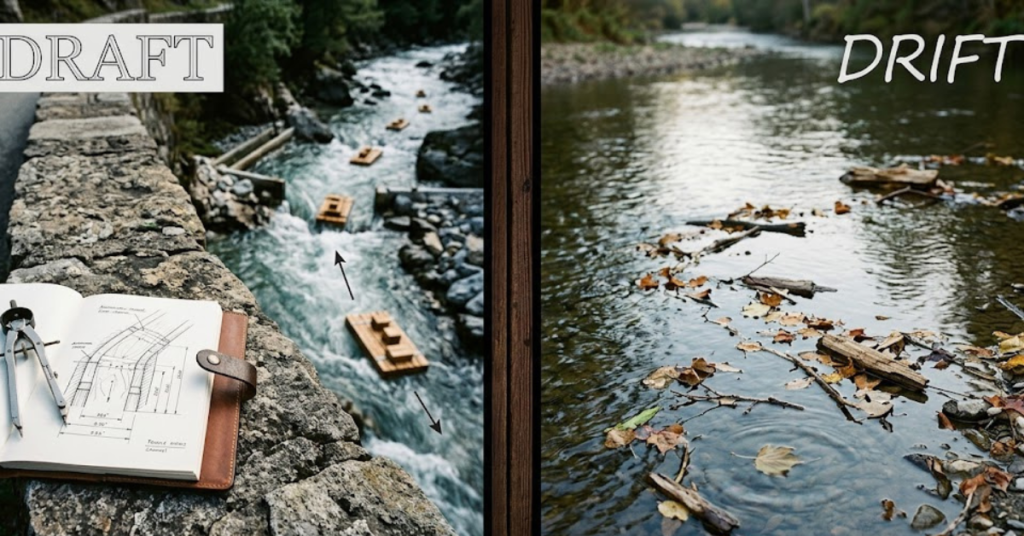

English is full of words that look and sound similar, making them easy to confuse. One pair that often causes uncertainty is draft vs drift. Although these words differ by only one letter, they have completely different meanings and are used in very different contexts.
Understanding draft vs drift can help you communicate more accurately, whether you’re writing an email, discussing weather conditions, talking about movement, or creating a first version of a document. In this guide, we’ll break down the meanings, uses, examples, and memory tricks that make it easy to distinguish between these commonly confused words.
Why Do People Confuse Draft and Drift?
The confusion between draft vs drift usually comes from their similar spelling and pronunciation. Both words contain five letters, share the same ending, and can function as nouns or verbs.
However, that’s where the similarity ends.
- Draft often relates to plans, writing, or moving air.
- Drift generally refers to movement, wandering, or gradual change.
Knowing the context is the key to choosing the correct word.
What Does Draft Mean?
The word draft has several meanings depending on how it’s used.
Draft Definition
As a noun, draft can refer to:
- A preliminary version of a document
- A current of cool air in a room
- A selection process, such as a sports draft or military draft
As a verb, draft means:
- To prepare or write an initial version
- To create plans or designs
Examples of Draft in Sentences
- I finished the first draft of my article.
- Please review the draft before publication.
- A cold draft came through the open window.
- The architect drafted the building plans.
Common Uses of Draft
You’ll often encounter draft in:
- Writing and publishing
- Business documents
- Architecture and engineering
- Sports recruitment
- Military service discussions
What Does Drift Mean?
The word drift generally refers to movement, especially movement that happens gradually or without clear direction.
Drift Definition
As a noun, drift can mean:
- Slow movement
- A tendency or general direction
- Accumulated material moved by wind or water
As a verb, drift means:
- To move slowly without control
- To wander away from a position or topic
- To change gradually over time
Examples of Drift in Sentences
- The boat began to drift away from shore.
- Snow drift covered the roadway.
- Their conversation drifted to another topic.
- He drifted away from his original career plans.
Common Uses of Drift
You’ll frequently see drift used in:
- Weather reports
- Ocean and river navigation
- Personal development discussions
- Scientific studies
- Everyday conversations
Draft vs Drift: Key Differences
The easiest way to understand draft vs drift is to focus on their core meanings.
Draft
Associated with:
- Writing
- Planning
- Designing
- Air currents
- Selection processes
Examples:
- Draft proposal
- Draft document
- Draft agreement
- Draft plan
Drift
Associated with:
- Movement
- Wandering
- Gradual change
- Direction
- Flow
Examples:
- Drift away
- Drift current
- Cultural drift
- Snow drift
A simple distinction is:
Draft creates something.
Drift moves something.
Draft vs Drift Examples
Looking at both words side by side makes the difference clearer.
Correct Use of Draft
- She submitted the first draft of her novel.
- The manager reviewed the contract draft.
- A draft entered through the doorway.
- Engineers drafted the construction plans.
Correct Use of Drift
- The kayak started to drift downstream.
- The discussion drifted off-topic.
- Sand drifts formed along the highway.
- His interests gradually drifted toward photography.
Notice that draft often involves preparation or creation, while drift involves movement or change.
Different Meanings of Draft
One reason people struggle with draft vs drift is that draft has multiple meanings.
Draft in Writing
The most common meaning is an early version of a written work.
Examples:
- Essay draft
- Book draft
- Contract draft
- Report draft
Draft in Airflow
A draft can also mean a flow of air entering a space.
Example:
- We closed the window to stop the draft.
Draft in Sports
Many professional sports leagues use a draft system to recruit players.
Example:
- The athlete was selected in the first round of the draft.
Different Meanings of Drift
Like draft, the word drift has several uses.
Drift as Movement
This is the most common meaning.
Example:
- The raft drifted across the lake.
Drift as Change
Drift can describe gradual shifts in ideas, behavior, or trends.
Example:
- Public opinion began to drift over time.
Drift in Nature
Wind, snow, sand, and ocean currents often create drifts.
Examples:
- Snow drift
- Sand drift
- Ocean drift
Common Mistakes with Draft and Drift
Because these words are visually similar, writers sometimes use the wrong one.
Incorrect Examples
- I submitted the first drift of my report.
- The boat draft slowly toward shore.
Correct Versions
- I submitted the first draft of my report.
- The boat drifted slowly toward shore.
Always ask yourself whether you’re talking about creating something or moving something.
Memory Tricks for Draft vs Drift
Simple memory techniques can help you remember the difference.
Remember Draft
Think of:
- Draft = Document
- Draft = Design
- Draft = Develop
The letter “A” in draft can remind you of Article or Arrangement.
Remember Drift
Think of:
- Drift = Direction
- Drift = Distance
- Drift = Movement
The word often implies motion or gradual change.
Origins of the Words
The history of these words also reflects their meanings.
Origin of Draft
Draft comes from old Germanic roots associated with drawing, pulling, and creating.
Over time, it became connected to written documents, plans, and designs.
Origin of Drift
Drift originates from words related to driving, moving, and carrying along.
Its modern meanings still revolve around movement and direction.
Draft vs Drift in Professional Communication
These words appear frequently in workplace communication.
When to Use Draft
Use draft when discussing:
- Reports
- Contracts
- Emails
- Plans
- Proposals
Example:
- Please review the draft before sending it to the client.
When to Use Drift
Use drift when discussing:
- Changing priorities
- Strategic direction
- Market trends
- Topic changes
Example:
- The meeting began to drift away from the main agenda.
Related Words and Synonyms
Synonyms for Draft
Depending on context:
- Outline
- Sketch
- Plan
- Proposal
- Preliminary version
Synonyms for Drift
Depending on context:
- Wander
- Float
- Move
- Shift
- Veer
These alternatives can help reinforce the distinction between the two words.
Frequently Asked Questions
What is the difference between draft and drift?
The main difference in draft vs drift is that draft relates to creating, planning, or writing, while drift refers to movement, wandering, or gradual change.
Is draft the same as drift?
No. Although they look similar, they have completely different meanings and uses.
What does draft mean in writing?
A draft is an initial or preliminary version of a document before it is finalized.
What does drift mean?
Drift means to move gradually, wander, float, or change direction over time.
Can drift be used metaphorically?
Yes. Drift is often used to describe gradual changes in opinions, goals, conversations, or behavior.
What is a draft document?
A draft document is an unfinished version prepared for review, editing, or approval before the final version is produced.
Conclusion
Understanding draft vs drift is easier once you focus on their core meanings. A draft is usually something being created, planned, written, or designed, while a drift involves movement, wandering, or gradual change. Although the two words differ by only one letter, they belong in very different contexts.
Whenever you’re unsure, remember this simple rule: draft creates, drift moves. Keeping that distinction in mind will help you avoid common mistakes, improve your writing accuracy, and communicate more effectively in both professional and everyday situations. If you’re interested in strengthening your vocabulary further, exploring other commonly confused word pairs can be an excellent next step.