
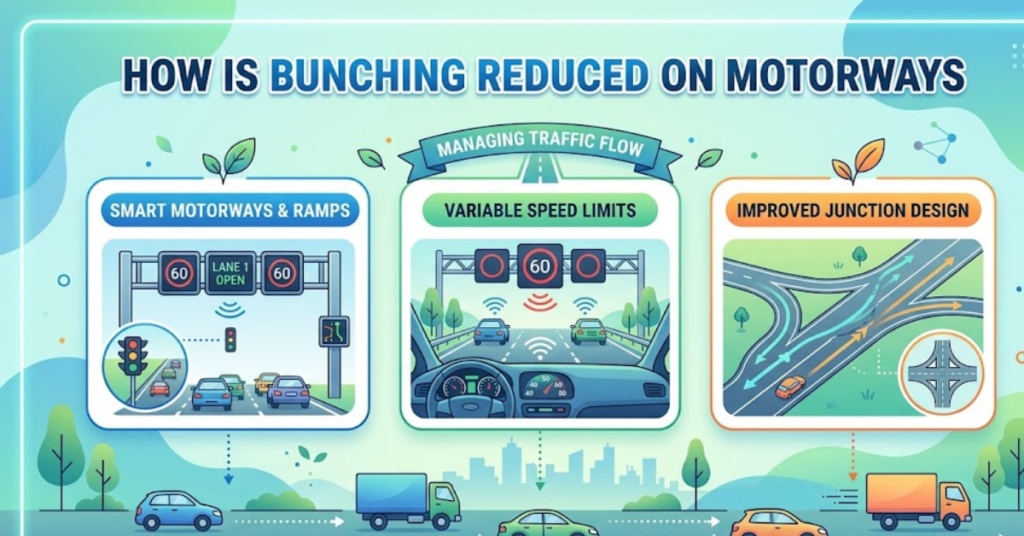

Have you ever been driving on a motorway only to find traffic suddenly slowing down for no obvious reason? One of the main causes of these frustrating delays is a phenomenon known as bunching. If you’ve ever wondered how is bunching reduced on motorways, you’re not alone.
Modern motorway systems are designed to keep traffic flowing smoothly and safely. Through the use of smart technology, traffic monitoring, and driver awareness, road authorities work to prevent vehicles from clustering too closely together. Understanding how bunching occurs—and how it’s managed—can help drivers stay safer and contribute to better traffic flow.
In this guide, we’ll explain what bunching is, why it happens, and the methods used to reduce it on today’s motorways.
What Is Bunching on Motorways?
Bunching occurs when groups of vehicles become crowded together on a stretch of road rather than being evenly spaced.
This often happens when:
- Drivers brake suddenly
- Traffic volume increases
- Vehicles change lanes frequently
- Roadworks or incidents create bottlenecks
- Drivers fail to maintain safe following distances
When vehicles bunch together, the risk of collisions increases, and traffic flow becomes less efficient.
Why Is Bunching a Problem?
Bunching may seem like a minor inconvenience, but it can have serious consequences.
Increased Accident Risk
When vehicles travel too closely together, drivers have less time to react to hazards. This can lead to rear-end collisions and chain-reaction crashes.
Traffic Congestion
Small disturbances can quickly spread through dense traffic, creating “shockwave” traffic jams that persist long after the original cause disappears.
Reduced Journey Reliability
Bunched traffic tends to stop and start repeatedly, increasing travel times and fuel consumption.
How Is Bunching Reduced on Motorways?
The primary answer to how is bunching reduced on motorways is through traffic management systems designed to control vehicle speeds and spacing.
Variable Speed Limits
One of the most effective tools for reducing bunching is the use of variable speed limits.
Electronic signs above the motorway display speed limits that can change according to traffic conditions.
Benefits include:
- Smoother traffic flow
- Reduced sudden braking
- More consistent vehicle spacing
- Lower accident rates
By slowing vehicles slightly before congestion develops, traffic managers can prevent clusters from forming.
Smart Motorways and Active Traffic Management
Many modern motorways use intelligent traffic management systems.
These systems monitor:
- Vehicle speeds
- Traffic density
- Congestion levels
- Incidents and breakdowns
- Weather conditions
When potential congestion is detected, the system automatically adjusts speed limits to spread traffic more evenly across the road network.
Lane Control Signals
Lane control signals help regulate traffic flow by directing vehicles away from hazards or congested areas.
These signals may:
- Close lanes temporarily
- Direct traffic into available lanes
- Warn drivers of upcoming incidents
Keeping vehicles distributed evenly across lanes helps prevent bunching.
The Role of Variable Speed Limits in Preventing Bunching
Creating Consistent Traffic Flow
Many drivers assume slowing down causes congestion. In reality, controlled speed reductions often improve overall traffic movement.
For example:
- Traffic ahead begins to slow.
- Speed limits are reduced gradually.
- Drivers adjust speed earlier.
- Harsh braking is avoided.
- Traffic remains smoother.
This process reduces the accordion effect, where repeated braking causes traffic waves to travel backward through the motorway.
Reducing Stop-Start Traffic
Stop-start traffic is a major contributor to bunching. Variable speed limits help eliminate abrupt speed changes and keep vehicles moving at a more uniform pace.
How Drivers Can Help Reduce Bunching
Traffic management systems are effective, but driver behavior remains critical.
Maintain a Safe Following Distance
Leave adequate space between your vehicle and the one ahead.
Benefits include:
- More reaction time
- Smoother braking
- Reduced collision risk
- Better traffic flow
Avoid Unnecessary Lane Changes
Frequent lane switching can disrupt traffic and contribute to bunching.
Choose a lane appropriate for your speed and remain in it whenever possible.
Follow Posted Speed Limits
Variable speed limits are designed to optimize traffic flow, not simply slow drivers down.
Obeying these limits helps prevent congestion from developing.
Stay Alert
Pay attention to:
- Overhead signs
- Traffic conditions
- Lane control signals
- Changes in traffic speed
Early reactions help maintain smooth vehicle spacing.
Smart Motorways and Traffic Flow Management
Smart motorways use technology to manage traffic more efficiently than traditional road systems.
Features may include:
- Variable speed limits
- Dynamic lane control
- Traffic monitoring cameras
- Incident detection systems
- Electronic message signs
Together, these tools help reduce bunching, improve safety, and maximize road capacity.
Common Causes of Motorway Bunching
Understanding the causes can help drivers avoid contributing to the problem.
Sudden Braking
One driver’s sharp braking can trigger a chain reaction affecting hundreds of vehicles.
Heavy Traffic Volumes
As traffic density increases, maintaining even spacing becomes more difficult.
Road Incidents
Accidents, breakdowns, and roadworks often force vehicles into smaller areas, creating congestion.
Poor Driver Discipline
Tailgating, speeding, and excessive lane changes all increase the likelihood of bunching.
Benefits of Reducing Bunching on Motorways
Reducing bunching offers significant advantages for everyone on the road.
Improved Safety
More space between vehicles means fewer collisions and safer driving conditions.
Better Traffic Flow
Evenly spaced traffic moves more efficiently than tightly packed traffic.
Reduced Emissions
Smooth driving requires less braking and acceleration, lowering fuel consumption and emissions.
Shorter Travel Times
Preventing congestion helps drivers reach their destinations more predictably.
FAQs
How is bunching reduced on motorways?
Bunching is primarily reduced through variable speed limits, lane control systems, traffic monitoring technology, and smart motorway management.
What causes bunching on motorways?
Common causes include sudden braking, heavy traffic, accidents, roadworks, tailgating, and frequent lane changes.
Do variable speed limits really reduce congestion?
Yes. Variable speed limits help maintain consistent traffic flow, reduce sudden braking, and prevent traffic from clustering too closely together.
What are smart motorways?
Smart motorways use technology such as variable speed limits, electronic signs, and traffic monitoring systems to improve safety and traffic efficiency.
How can drivers help reduce bunching?
Drivers can maintain safe following distances, avoid unnecessary lane changes, obey speed limits, and stay alert to traffic conditions.
Does bunching increase accident risk?
Yes. When vehicles travel too closely together, drivers have less time to react, increasing the likelihood of collisions.
Conclusion
Understanding how is bunching reduced on motorways is essential for safer and more efficient driving. Modern traffic management systems, particularly variable speed limits and smart motorway technology, play a major role in preventing vehicles from clustering together and causing congestion.
However, technology alone isn’t enough. Drivers also contribute by maintaining safe distances, avoiding aggressive driving behaviors, and following traffic guidance. When both road systems and drivers work together, motorways become safer, smoother, and more reliable for everyone.
If you’re interested in improving your driving knowledge further, consider exploring related topics such as smart motorways, motorway safety rules, and defensive driving techniques.