
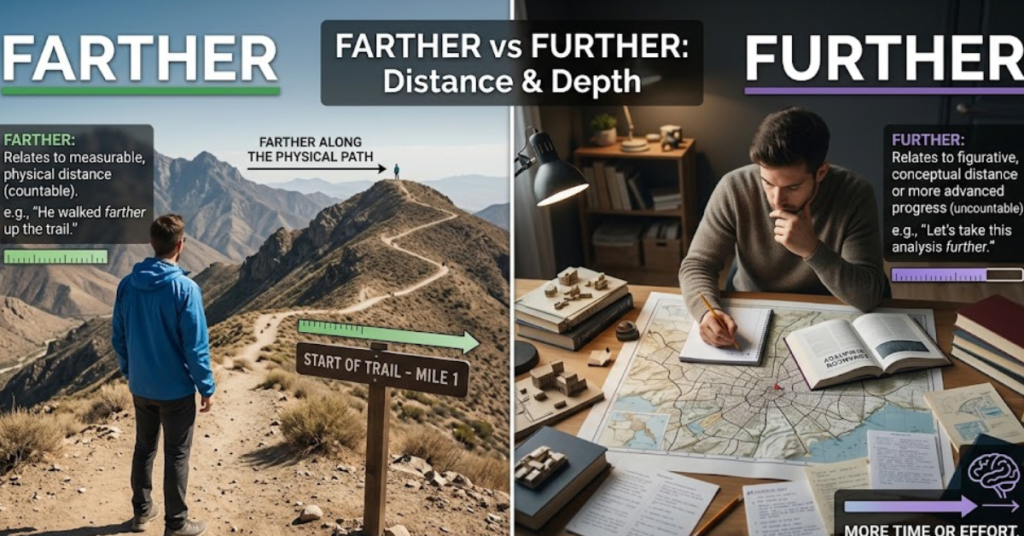

If you’ve ever hesitated while writing and wondered about farther vs further, you’re not alone. These two words look almost identical and are often used interchangeably, but traditional grammar still makes a subtle distinction between them.
Both words relate to distance and progress, but they are not always used in the same way. Once you understand the logic behind them, the confusion becomes much easier to avoid.
In this guide, we’ll break down meanings, rules, examples, and simple tricks so you always know which word to choose.
Farther vs Further Meaning Explained
To understand the difference, start with their core meanings:
- Farther = physical distance
- Further = abstract or figurative distance (ideas, progress, time, or degree)
Simple Breakdown:
- Farther → measurable space
- Further → non-physical or additional extent
This basic idea forms the foundation of their correct usage.
Key Difference in Simple Words
The distinction is subtle but important:
- Use farther when you measure physical distance
- Use further when you talk about ideas, progress, or development
Examples:
- The school is farther than the park. (distance)
- We need to discuss this further. (discussion)
When to Use Each Word
Use “Farther” for:
- Physical distance
- Measurable movement
Examples:
- He ran farther than his friend.
- The shop is farther down the road.
Use “Further” for:
- Ideas or concepts
- Progress or development
- Additional time or discussion
Examples:
- We need further clarification.
- The project will expand further next year.
Time Usage Explained
A common question is how these words relate to time.
- Further is used for time or progression
- Farther is not used for time in standard English
Example:
- We will discuss this further next week.
- (Not correct: “farther next week”)
So for time-related meanings, “further” is always the safer choice.
Usage Examples in Real Sentences
Physical Distance:
- She can swim farther than I can.
- The journey is farther than expected.
- He walked farther into the forest.
Abstract or Figurative Meaning:
- We will investigate further.
- Do you have any further questions?
- The company expanded further into Asia.
Modern English Usage
In modern English, especially in informal contexts, people sometimes mix both words.
- British English often prefers “further” in most cases
- American English maintains a clearer distinction between physical and abstract meaning
However, in everyday conversation, “further” is becoming more widely accepted overall.
Easy Memory Trick
Use this simple rule:
- If you can measure it → use farther
- If you cannot measure it → use further
Example:
- Distance you can measure → farther
- Ideas or progress → further
This trick makes the choice quick and easy.
Pronunciation Note
Both words are pronounced almost the same:
- Farther → /ˈfɑːrðər/
- Further → /ˈfɜːrðər/
Because they sound alike, confusion often happens in speech as well as writing.
Common Mistakes
People often:
- Use “farther” for abstract ideas
- Ignore context completely
- Overthink simple sentences
Understanding context helps avoid these mistakes easily.
Quick Practice Quiz
Fill in the blanks:
- The car went ___ than before.
- We need ___ discussion on this topic.
- She walked ___ into the city.
- The investigation will continue ___.
Answers:
- Farther
- Further
- Farther
- Further
FAQs
What is the main difference?
One refers to physical distance, the other to abstract ideas or progress.
Can I use further for distance?
Yes, in modern English it is often accepted, but “farther” is more precise.
Which is more common?
“Further” is more commonly used in everyday English.
Is this distinction still important?
Yes, especially in formal or academic writing.
What is the easiest way to remember?
Use “farther” for measurable distance and “further” for everything else.
Conclusion
The difference between these two words becomes simple once you focus on meaning rather than spelling. One deals with physical distance, while the other covers ideas, progress, and abstract concepts.
To summarize:
- Farther = measurable distance
- Further = ideas, progress, or time
With a little practice, choosing the correct word becomes natural and automatic in your writing.