
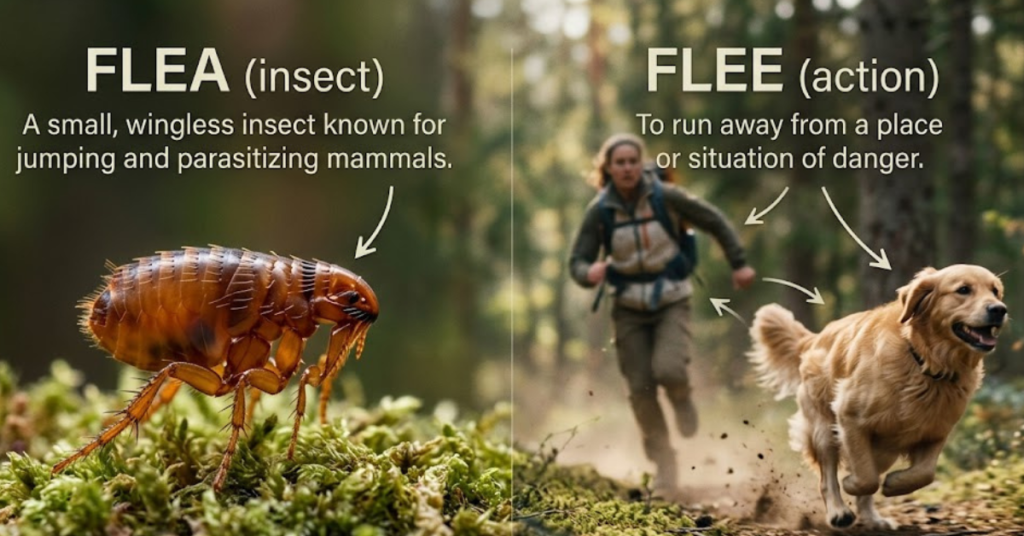

If you’ve ever been confused by flea vs flee, you’re definitely not alone. These two words look almost identical, sound similar, and yet they mean completely different things in English. That’s exactly why they trip up so many learners.
The confusion around flea vs flee often comes from pronunciation and spelling similarity, but once you understand their meanings, the difference becomes very clear. One refers to a tiny insect, while the other describes escaping quickly.
In this guide, we’ll break down their meanings, usage, pronunciation tips, and simple tricks to remember the difference forever.
Flea vs Flee: What Do They Mean?
To understand flea vs flee, you first need to know what each word means individually.
Flea (noun)
A flea is:
- A tiny, wingless insect
- A parasite that feeds on animals and humans
- Known for causing itching and irritation
Flee (verb)
To flee means:
- To run away quickly
- To escape danger or a threatening situation
- A sudden act of leaving
So the core difference is simple:
- Flea = insect
- Flee = action (escape)
Flea vs Flee Pronunciation Difference
Even though flea vs flee look similar, they are pronounced the same: “flee.”
This is where confusion often happens:
- Flea → /flee/
- Flee → /flee/
Since they sound identical, context is the only way to tell them apart in conversation.
Flea vs Flee Meaning in Real-Life Usage
Understanding flea vs flee meaning becomes easier with examples.
Flea (insect):
- The dog has fleas.
- Fleas are difficult to remove without treatment.
Flee (escape):
- The villagers had to flee the flood.
- The thief tried to flee the scene.
Even though they sound the same, their meanings are completely unrelated.
Flea vs Flee in Grammar
From a grammar perspective, flea vs flee belongs to two different word categories.
Flea:
- Noun
- Refers to a living organism
Flee:
- Verb
- Refers to an action
This difference helps determine how each word functions in a sentence.
Flea vs Flee Examples in Sentences
Here are clear examples to understand flea vs flee better:
Using “flea”:
- The cat is scratching because of fleas.
- Flea bites can be very irritating.
Using “flee”:
- The people had to flee the burning building.
- Birds flee when they sense danger.
The context instantly clarifies the meaning.
Why People Confuse Flea vs Flee
The confusion between flea or flee happens for a few reasons:
- They are pronounced exactly the same
- They differ by only one letter
- Learners rely on sound rather than spelling
- Fast typing leads to mistakes
Even native speakers occasionally mix them up in writing.
Simple Trick to Remember Flea vs Flee
Here’s an easy memory trick:
- Flea = “E” for “insect Exterminator problem”
- Flee = “EE” like “Escape Quickly”
Another way:
- Flea = tiny creature
- Flee = fast action
These associations make the difference easier to remember.
Common Mistakes with Flea vs Flee
People often make errors like:
- Writing “flea” when they mean escape
- Using “flee” in insect contexts
- Mixing them in fast writing or texting
These mistakes can completely change the meaning of a sentence.
Flea or Flee in Everyday English
Both words appear frequently in different contexts:
Flea:
- Pet care discussions
- Veterinary advice
- Hygiene and cleaning topics
Flee:
- News reports
- Emergency situations
- Storytelling and literature
Understanding context helps avoid confusion.
Flea vs Flee in Writing and Exams
In exams and formal writing, flea or flee errors are considered basic spelling mistakes.
To avoid losing marks:
- Double-check spelling
- Read sentences aloud
- Focus on context clues
Even small errors can affect clarity in academic writing.
FAQs
What is the difference between flea or flee?
“Flea” is an insect, while “flee” means to run away quickly.
Why do flea and flee sound the same?
They are homophones in English, meaning they share the same pronunciation.
Is flea an action word?
No, flea is a noun referring to an insect.
What does flee mean in simple English?
It means to escape or run away from danger.
How can I remember flea or flee easily?
Think: flea = insect, flee = escape action.
Conclusion
The confusion around flea vs flee is completely normal because the words look and sound similar. However, their meanings are very different—one refers to a tiny insect, and the other describes escaping quickly from danger.
Once you remember that flea is a noun and flee is a verb, the difference becomes easy and intuitive. With a little practice, you’ll never mix them up again in writing or conversation.