
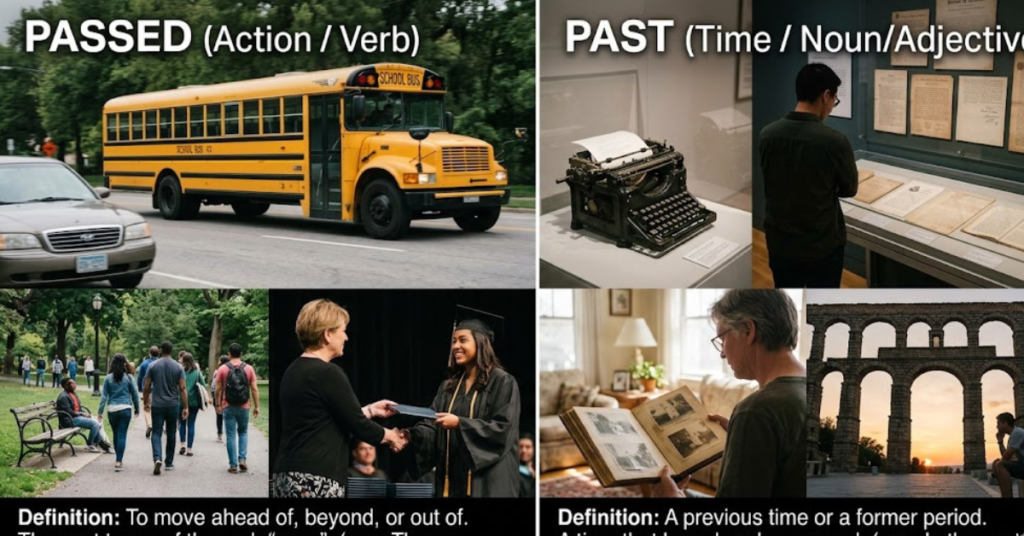

The confusion between passed vs past is one of the most common grammar challenges in English. These two words look similar, sound similar, but they have completely different meanings and uses.
If you’ve ever paused while writing a sentence like “I walked passed/past the school” or wondered about passed vs past meaning, you’re not alone. Even native speakers mix them up sometimes.
In this guide, we’ll break down the passed or past difference grammar, explain when to use passed vs past, and give you simple examples so you never get confused again.
Passed vs Past Meaning (Simple Explanation)
To understand passed or past meaning, you need to look at their grammar roles.
Passed Meaning
“Passed” is the past tense of the verb “pass.”
It refers to action, such as:
- Moving by something
- Completing a test
- Giving something to someone
- Time going by
Example:
- She passed the exam.
- He passed the shop on his way home.
Past Meaning
“Past” is usually a preposition, noun, adjective, or adverb, not a verb.
It refers to:
- Time before now
- Movement beyond a place
- History or earlier events
Example:
- The danger is in the past.
- He walked past the shop.
Passed vs Past Definition and Grammar Difference
Understanding the passed or past definition helps you avoid mistakes.
Passed or Past Grammar Difference
- Passed = action word (verb)
- Past = position, time, or direction word (not a verb)
A simple rule:
- If it’s something someone does, use passed
- If it refers to time or location, use past
This is the core of passed or past grammar examples.
When to Use Passed or Past
Knowing when to use passed or past makes writing much easier.
Use “Passed” When:
- Talking about exams or tests
- Describing movement as an action
- Talking about time going by
- Giving or transferring something
Examples:
- I passed my driving test.
- Time passed quickly.
- She passed the message to him.
Use “Past” When:
- Referring to time before now
- Describing movement beyond something
- Talking about history or earlier events
Examples:
- He lives in the past.
- We walked past the station.
- Don’t look back at the past.
Passed or Past Examples in Real Sentences
Here are clear passed vs past examples to help you understand usage naturally.
- She passed me on the street.
- We walked past the market.
- He passed the final exam easily.
- The train went past the station.
- Years passed before they met again.
These examples show how small changes completely change meaning.
Common Confusions in Passed vs Past Usage
1. Walked Passed vs Past
A common mistake is saying walked passed vs past.
Correct:
- I walked past the school.
Incorrect:
- I walked passed the school.
2. Walk Passed vs Past
Another error is walk passed vs past.
Correct:
- They walk past the park every day.
3. Get Passed vs Past
People often confuse get passed vs past.
Correct usage:
- He got passed over for promotion (verb usage context)
But:
- He walked past the building
4. Look Passed vs Past
The phrase look passed vs past is also commonly misused.
Correct:
- Look past the mistakes and move on.
Passed vs Past Time and Years Passed vs Past
Passed or Past Time
When talking about time:
- Time passed slowly.
- The past few days were difficult.
Years Passed or Past
- Many years passed before they returned.
- In the past years, technology has changed.
Passed or Past Away (Common Confusion)
A sensitive but important usage is passed or past away.
Correct expression:
- “Passed away” means someone died respectfully.
Example:
- Her grandfather passed away last year.
Incorrect:
- Her grandfather past away
Passed or Past Quiz and Learning Tip
If you’re trying a passed vs past quiz, remember this quick trick:
Ask yourself:
- Is it an action? → Use passed
- Is it time or location? → Use past
This simple check works in almost every case.
Pass or Passed or Past (Quick Breakdown)
Understanding pass or passed or past makes everything clearer:
- Pass = base verb (present)
- Passed = past tense of verb
- Past = preposition/noun/adjective
Example:
- I pass the school every day.
- I passed the school yesterday.
- The school is in the past of my memory (figurative use).
Passed or Past Grammar Girl Style Tip
A helpful passed or past grammar girl style trick is:
“Passed has action. Past has position or time.”
Keep that in mind and you’ll rarely make mistakes again.
FAQs on Passed or Past
1. What is the difference between passed or past?
“Passed” is a verb showing action, while “past” refers to time or position.
2. When should I use passed or past?
Use “passed” for actions and “past” for time, history, or location.
3. Is it walked passed or walked past?
Correct: walked past.
4. What is passed or past meaning in simple words?
Passed = did something. Past = before now or beyond something.
5. Can passed and past be used in the same sentence?
Yes. Example: He passed me while walking past the shop.
6. What is passed or past away?
“Passed away” is a polite way to say someone died.
Conclusion
Understanding passed vs past difference grammar is simple once you know the rule: passed is an action, past is about time or position. Whether you’re writing essays, messages, or everyday sentences, using them correctly improves clarity and confidence.
Now that you’ve learned when to use passed or past, try practicing with your own sentences. The more you use them, the easier they become—and soon, you won’t hesitate again when choosing between passed vs past.