
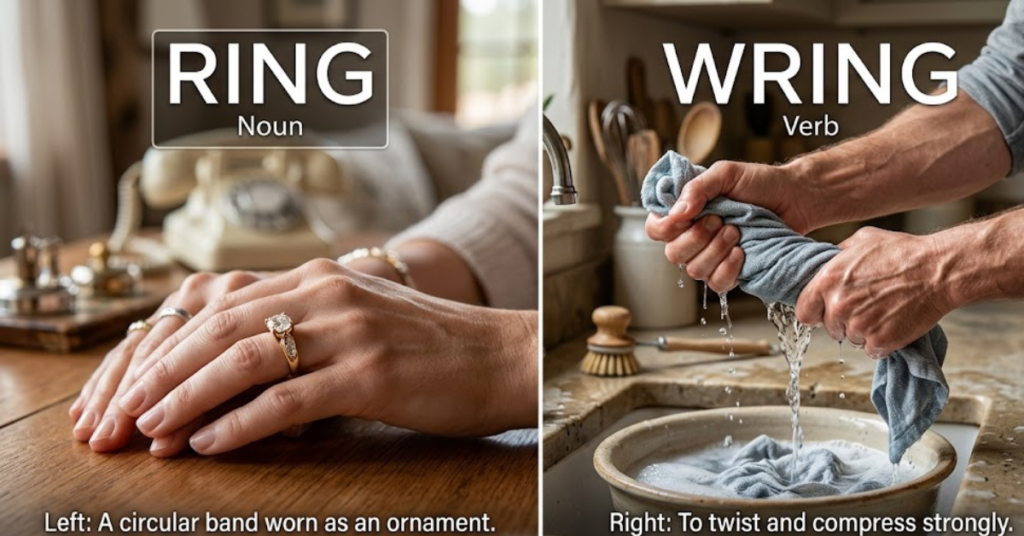

English can be surprisingly confusing when two words sound alike but have completely unrelated meanings. One commonly misunderstood pair is ring vs wring. Since these words are pronounced similarly, many people accidentally confuse them in writing, especially when typing quickly or relying on autocorrect.
Understanding the difference matters because each word serves a completely different purpose in English. One is connected to sounds, shapes, and jewelry, while the other refers to twisting or squeezing something forcefully.
This guide explains the meanings, pronunciation, examples, grammar rules, and memory tricks behind these commonly mixed-up words in a clear and practical way.
What Is the Difference Between Ring vs Wring?
The main difference lies in meaning.
- Ring usually refers to a circular object, a sound, or the action of calling someone.
- Wring means to twist, squeeze, or force liquid out of something.
Although they sound very similar, they are used in entirely different contexts.
Meaning of Ring
The word “ring” has several common meanings in everyday English.
Ring as a Circular Object
This meaning refers to something shaped like a circle.
Examples:
- She wore a gold ring.
- The children formed a ring around the fire.
Ring as a Sound
Ring can also describe a bell-like sound.
Examples:
- I heard the phone ring.
- The church bells rang loudly.
Ring as a Phone Call
People often use “ring” informally when talking about calling someone.
Examples:
- I’ll ring you later.
- Please ring the office tomorrow.
Meaning of Wring
The word “wring” usually involves twisting or squeezing something with force.
Wring Out Meaning
This phrase commonly refers to removing water from fabric.
Examples:
- Wring out the towel before hanging it.
- She wrung the water from the cloth.
Wring Hands Meaning
This expression describes anxiety or worry.
Examples:
- He stood there wringing his hands nervously.
- The parents wrung their hands during the wait.
Wring Information From Someone
Sometimes wring means forcing information or emotions from someone.
Example:
- The reporter tried to wring details from the witness.
Ring vs Wring Pronunciation
These words sound extremely similar in modern English.
Ring Pronunciation
- /rɪŋ/
Wring Pronunciation
- /rɪŋ/
The “w” in wring is silent, making both words perfect homophones.
Because pronunciation cannot distinguish them, spelling and context become essential.
How to Use “Ring” Correctly
The word ring can function as both a noun and a verb.
Ring as a Noun
Examples:
- The diamond ring was expensive.
- Smoke formed a ring in the air.
Ring as a Verb
Examples:
- Please ring the bell.
- My phone rang during dinner.
The meaning changes depending on context, but it usually relates to sound, circles, or communication.
How to Use “Wring” Correctly
Wring is mostly used as a verb.
Common Uses of Wring
Examples:
- Wring the water from the shirt.
- She wrung the rag dry.
- He wrung his cap nervously.
The word often suggests pressure, twisting, or emotional tension.
Why People Confuse Ring and Wring
Several factors contribute to the confusion.
Identical Pronunciation
Since the words sound exactly the same, spelling errors are common.
Silent Letters in English
The silent “w” in wring creates additional confusion for learners.
Similar Sentence Structure
Both words often appear as verbs, increasing the chance of accidental misuse.
Easy Memory Tricks
Simple associations can make the difference easier to remember.
Remember Ring With Circles and Sounds
Think:
- Wedding ring
- Ringing phone
- Bell ring
The word usually connects to sound or circular shapes.
Remember Wring With Twisting
Think:
- Wring a towel
- Twist water out
- Wring hands nervously
The “wr” beginning often appears in words involving twisting or movement, like:
- Wrench
- Wrestle
- Writhe
Common Sentences Using Ring and Wring
Examples help clarify the difference quickly.
Ring
- The alarm will ring at 6 a.m.
- He bought her a silver ring.
- I’ll ring you after work.
Wring
- Wring the mop before cleaning again.
- She wrung the cloth dry.
- He wrung his hands in frustration.
Ring vs Wring in Grammar
Using the wrong word can completely change a sentence.
Incorrect:
- “Please wring the doorbell.”
Correct:
- “Please ring the doorbell.”
Incorrect:
- “She rang the towel dry.”
Correct:
- “She wrung the towel dry.”
Careful spelling matters because these words describe very different actions.
Common Expressions With Ring
English uses ring in many popular phrases.
Examples:
- Ring a bell
- Ring true
- Throw your hat in the ring
- Ring in the new year
These idioms often relate to sound, competition, or recognition.
Common Expressions With Wring
Wring appears in fewer expressions but remains important.
Examples:
- Wring your hands
- Wring out a towel
- Wring every drop out
These phrases usually involve squeezing, pressure, or emotional stress.
Why Context Is Important
Since pronunciation cannot separate these homophones, readers rely on surrounding words for meaning.
For example:
- “The phone will ring soon” clearly refers to sound.
- “Please wring out the cloth” clearly refers to squeezing.
Context makes the intended meaning obvious.
FAQs
What is the difference between ring vs wring?
Ring usually refers to sounds, phone calls, or circular objects, while wring means twisting or squeezing something forcefully.
Are ring and wring pronounced the same?
Yes. The “w” in wring is silent, so both words sound identical.
What does wring mean in laundry?
It means twisting fabric to remove water.
Can ring be used as a verb?
Yes. Ring can mean making a sound or calling someone by phone.
What does “wring your hands” mean?
It describes showing anxiety, stress, or nervousness through hand movements.
How can I remember the difference between ring and wring?
Associate ring with sounds and circles, and wring with twisting or squeezing.
Conclusion
Understanding ring vs wring becomes much easier once you focus on their meanings rather than their pronunciation. Although the words sound exactly alike, they describe completely different actions and ideas.
Ring commonly relates to sounds, communication, or circular objects, while wring involves twisting, squeezing, or emotional tension. Paying attention to context and spelling can help you avoid common writing mistakes and communicate more clearly.
Learning word pairs like these strengthens vocabulary, improves grammar accuracy, and builds confidence in both spoken and written English.