
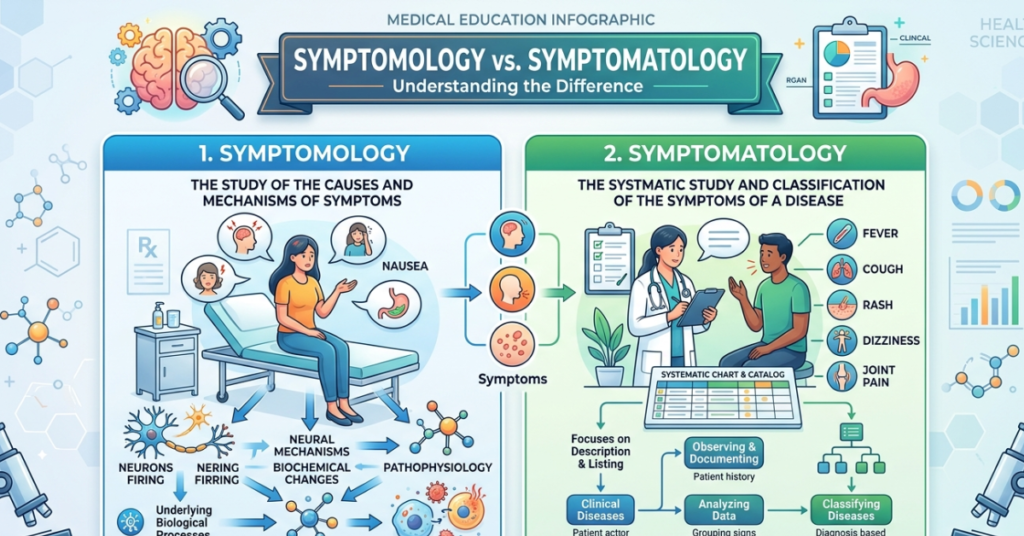

Ever stumbled across the terms symptomology and symptomatology and wondered if they mean the same thing? You’re not alone. The debate around symptomology vs symptomatology is more common than you might think, especially in healthcare, research, and everyday conversations about illness.
At first glance, the two words seem interchangeable. But dig a little deeper, and you’ll find that only one of them is considered technically correct in formal medical language. Let’s break it down in a way that’s clear, practical, and easy to remember.
What Does Symptomatology Mean?
Symptomatology is the study or collection of symptoms associated with a particular disease or condition. It’s widely accepted in medical and scientific communities.
Key points:
- Refers to all symptoms linked to a disease
- Used in clinical, academic, and research settings
- Considered the standard and correct term
Example:
A doctor might say, “The symptomatology of this condition includes fever, fatigue, and joint pain.”
In simple terms, it’s a structured way of describing how an illness presents itself.
What Is Symptomology?
Symptomology is often used as a shortened or informal version of symptomatology. However, it’s not traditionally recognized as a formal medical term.
Key points:
- Considered non-standard or informal
- Common in casual speech or non-medical writing
- Sometimes viewed as a linguistic shortcut
Example:
You might hear someone say, “The symptomology seems unusual,” especially outside strict medical contexts.
While people understand what it means, professionals usually avoid it in formal communication.
Symptomology vs Symptomatology: The Core Difference
Here’s the simplest way to understand symptomology vs symptomatology:
| Aspect | Symptomatology | Symptomology |
| Accuracy | Correct term | Informal/less accurate |
| Usage | Medical & academic | Casual conversation |
| Recognition | Widely accepted | Limited acceptance |
| Precision | High | Lower |
Bottom line:
- Symptomatology = correct and preferred
- Symptomology = commonly used but technically incorrect
Why Does the Confusion Exist?
Language evolves, and people tend to shorten words for convenience. That’s exactly what happened here.
Common reasons for confusion:
- Both words sound nearly identical
- “-ology” is a familiar suffix in English
- Informal usage spreads quickly online and in speech
Over time, symptomology gained traction—even though it lacks formal backing.
When Should You Use Each Term?
Use “symptomatology” when:
- Writing academic papers
- Communicating in healthcare settings
- Creating professional or technical content
Use “symptomology” when:
- Speaking casually
- Writing informal content
- Addressing a general audience (with caution)
If you want to sound precise and credible, stick with symptomatology.
Related Terms You Should Know
To better understand this topic, it helps to be familiar with a few related concepts:
- Symptoms: Subjective experiences (e.g., pain, fatigue)
- Signs: Objective findings (e.g., rash, fever)
- Diagnosis: Identifying a disease based on symptoms and signs
- Pathology: Study of disease causes and effects
These terms often appear alongside discussions of symptomology vs symptomatology.
Common Mistakes to Avoid
When writing or speaking, keep these pitfalls in mind:
- Using symptomology in formal medical writing
- Assuming both terms are equally accepted
- Overusing technical language in casual settings
Instead, match your word choice to your audience and purpose.
FAQs
1. Is symptomology a real word?
Yes, but it’s considered informal and not widely accepted in medical or academic contexts.
2. Which is correct: symptomology or symptomatology?
Symptomatology is the correct and preferred term, especially in professional settings.
3. Why do people use symptomology?
It’s shorter and easier to say, which makes it popular in casual conversation.
4. Can I use symptomology in writing?
You can use it in informal writing, but avoid it in academic, scientific, or medical content.
5. Are the meanings different?
Not significantly. Both refer to symptoms, but symptomatology is more precise and widely accepted.
Conclusion
Understanding symptomology vs symptomatology comes down to knowing the difference between informal usage and professional accuracy. While both words point to the study of symptoms, only symptomatology holds up in clinical and academic environments.
If clarity and credibility matter—especially in writing—choose the term that experts rely on. And if you’re aiming to communicate effectively, matching your language to your audience will always make the biggest difference.
Curious about other commonly confused terms? Keep exploring—you’ll sharpen both your vocabulary and your confidence along the way.