
English is full of tricky word pairs, and extent vs extant is one that often causes confusion. At first glance, the words look almost identical—but their meanings are completely different.
In this guide, we’ll break down what each word means, how they’re used in real sentences, and how to avoid common mistakes. By the end, you’ll be able to use both terms confidently and correctly.
What Does “Extent vs Extant” Mean?
Understanding extent vs extant starts with defining each word clearly.
What Does “Extent” Mean?
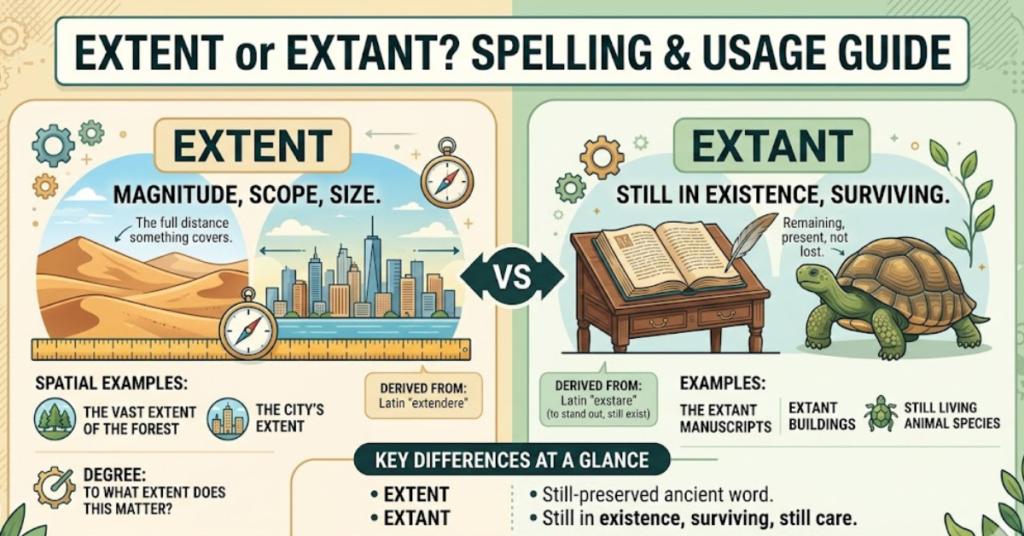
Extent refers to the size, degree, or scope of something.
In simple terms:
- How much
- How far
- How large or significant
Examples:
- The extent of the damage was surprising.
- We need to understand the full extent of the problem.
What Does “Extant” Mean?
Extant means something that still exists or survives, especially from the past.
In simple terms:
- Still in existence
- Not destroyed or lost
Examples:
- These are the only extant copies of the manuscript.
- Few extant records remain from that era.
Extent vs Extant Difference Explained
The key to mastering extent vs extant difference is remembering that one refers to degree, while the other refers to existence.
Core Difference
- Extent = amount or level
- Extant = still existing
Quick Comparison
- “To what extent is this true?”
- “Are there any extant documents?”
Even though they look similar, they serve completely different purposes in a sentence.
How to Use Extent Correctly
Extent is commonly used in both casual and formal English.
Common Uses of “Extent”
- Measuring impact or damage
- Describing scope or reach
- Discussing limits or boundaries
Example Sentences
- The study examined the extent of climate change effects.
- He didn’t realize the extent of her influence.
Helpful Tip
If you can replace the word with degree or amount, extent is the right choice.
How to Use Extant Correctly
Extant is less common but often appears in academic, historical, or formal writing.
Common Uses of “Extant”
- Historical documents
- Ancient artifacts
- Surviving works
Example Sentences
- Only a few extant letters from the author remain.
- The museum displays extant relics from ancient times.
Helpful Tip
If the sentence refers to something that still exists, use extant.
Why People Confuse Extent vs Extant
There are a few reasons this pair causes confusion.
Common Causes
- Similar spelling and pronunciation
- Both words appear in formal writing
- Lack of familiarity with extant
Because extent is more common, people sometimes use it incorrectly in place of extant.
Easy Ways to Remember the Difference
If you’re struggling with extent vs extant, these simple tricks can help.
Memory Hacks
- Extent has “e” like extent of something (amount)
- Extant has “ant” like ancient (still existing)
Quick Check
Ask yourself:
- Am I talking about how much? → Use extent
- Am I talking about still existing? → Use extant
Common Mistakes to Avoid
Even experienced writers mix these up occasionally.
1. Using “Extent” Instead of “Extant”
Incorrect:
- Few extent records remain
Correct:
- Few extant records remain
2. Using “Extant” for Degree
Incorrect:
- The extant of the damage was severe
Correct:
- The extent of the damage was severe
3. Avoiding “Extant” Altogether
Don’t shy away from using extant when it’s the correct word—it adds precision to your writing.
Real-Life Examples of Extent vs Extant
Seeing both words side by side can reinforce the difference.
- The extent of the fire damage shocked investigators.
- Only a few extant buildings survived the disaster.
- Researchers studied the extent of the disease.
- There are no extant samples from that period.
FAQs
What is the difference between extent vs extant?
Extent refers to degree or size, while extant means still existing.
Is extant a common word?
No, extant is less common and usually appears in formal or academic contexts.
Can extent and extant be used interchangeably?
No, they have completely different meanings and cannot replace each other.
How do I remember extant?
Think of extant as something from the past that still exists.
Is extent used more often?
Yes, extent is widely used in everyday language.
Conclusion
Mastering extent vs extant comes down to understanding one simple distinction: extent measures how much, while extant describes what still exists. Once you grasp this difference, choosing the correct word becomes much easier.
These small language details might seem minor, but they make a big difference in clarity and professionalism. Keep practicing, and soon you’ll use both words naturally without a second thought.
If you want to improve your writing further, exploring similar word pairs can help sharpen your vocabulary even more.