
If you’ve ever searched for dysregulation vs disregulation, you’ve probably noticed something confusing right away. Both words look similar, both sound believable, but only one is actually correct in psychology and medical writing.
This confusion shows up often in discussions about emotions, behavior, and mental health. So in this guide, we break down dysregulation vs disregulation in a simple, practical way so you understand what professionals actually mean and how to use the correct term confidently.
What Does Dysregulation Mean?
To understand dysregulation vs disregulation, you first need to understand dysregulation itself.
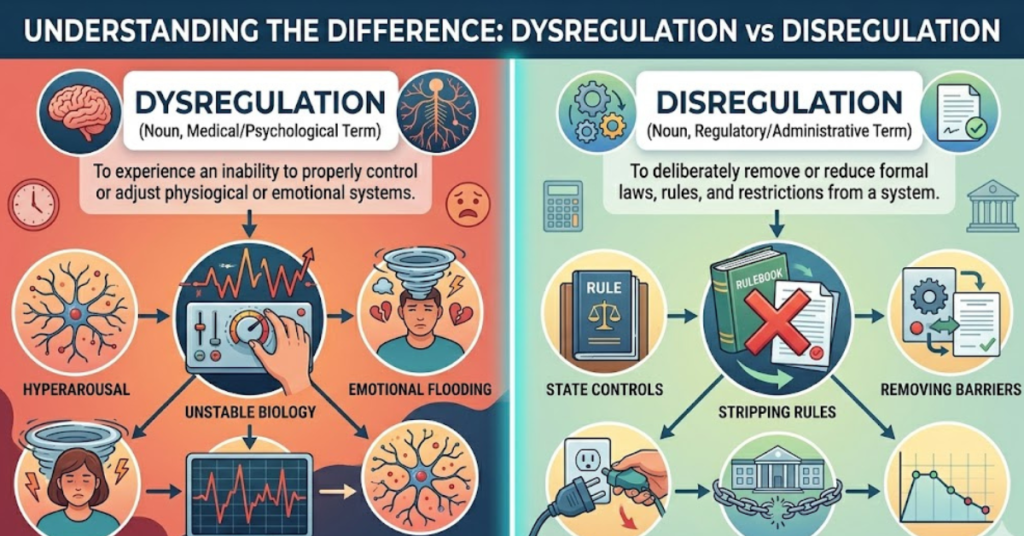
Dysregulation describes a situation where a person struggles to control or balance emotional, behavioral, or physical responses. The internal system that usually keeps things stable stops working properly.
In simple terms:
Dysregulation happens when emotions or reactions become too strong, too fast, or difficult to manage.
Types of dysregulation:
- Emotional dysregulation: intense mood swings or emotional reactions
- Behavioral dysregulation: impulsive actions or difficulty controlling behavior
- Physiological dysregulation: stress response or nervous system imbalance
Psychologists often use this term when discussing mental health conditions like anxiety, ADHD, trauma responses, and autism spectrum conditions.
Is “Disregulation” a Correct Term?
Now let’s directly address dysregulation vs disregulation.
“Disregulation” does not exist as a recognized psychological or medical term. People sometimes use it informally, but professionals avoid it completely.
Why it appears:
- People mishear “dysregulation”
- Typing errors or autocorrect mistakes
- Confusion between “dis” and “dys” prefixes
- Informal online discussions repeating the mistake
In professional writing, only dysregulation is accepted.
Dysregulation vs Disregulation: The Real Difference
The core of dysregulation vs disregulation is actually very simple.
- Dysregulation → Correct term used in psychology and medicine
- Disregulation → Incorrect, non-standard usage
There is no scientific definition or separate meaning for “disregulation.” It is simply a mistaken variation of the correct word.
So when psychologists talk about emotional or behavioral imbalance, they always use dysregulation.
Why the Confusion Happens So Often
People often mix up dysregulation vs disregulation because the words look and sound similar.
Here’s what causes the confusion:
- The prefixes “dis” and “dys” sound alike in speech
- Fast reading or writing leads to spelling errors
- Lack of exposure to psychological terminology
- Social media spreading incorrect versions
Once you know the correct form, you can easily avoid the mistake.
How Professionals Use Dysregulation
In clinical psychology, dysregulation plays an important role in understanding behavior and mental health.
Common areas where the term appears:
- Emotional regulation studies
- Trauma and PTSD research
- ADHD and attention-related conditions
- Autism spectrum discussions
- Stress and anxiety management
Real-life examples:
- A child struggles to calm down after frustration, showing emotional dysregulation
- An adult reacts impulsively under stress, showing behavioral dysregulation
- A person experiences intense anxiety due to nervous system dysregulation
These examples show how widely professionals use the correct term.
Easy Trick to Remember the Correct Term
If you still feel confused about dysregulation vs disregulation, use this simple memory trick:
Think of “dys” as meaning “difficulty or abnormal functioning.”
You’ll also see it in words like:
- Dysfunction
- Dyslexia
- Dysregulation
So whenever you talk about emotional or behavioral imbalance, dysregulation is always the correct choice.
FAQs About Dysregulation vs Disregulation
1. What is the correct term: dysregulation vs disregulation?
The correct term is dysregulation. “Disregulation” is not used in professional psychology.
2. What does dysregulation mean?
It means difficulty in controlling emotions, behavior, or physical responses.
3. Is disregulation a real word?
No, it is not a recognized term in psychology or medicine.
4. Why do people say disregulation?
People usually say it by mistake due to spelling or pronunciation confusion.
5. Where is dysregulation commonly used?
It is widely used in psychology, psychiatry, neuroscience, and therapy.
Conclusion
Understanding dysregulation vs disregulation becomes easy once you know the key fact: dysregulation is the only correct and professionally accepted term.
While “disregulation” may appear in casual writing, it has no official meaning in psychology. Dysregulation, on the other hand, plays an important role in explaining emotional, behavioral, and neurological patterns.
If you want to improve your understanding of mental health concepts, mastering terms like this gives you a strong foundation. Keep practicing, and you’ll quickly recognize the correct usage in any context.