
If you’ve ever come across Faring vs Fairing and felt confused, you’re not alone. These two words look almost identical, sound similar, and often show up in different contexts—but they mean completely different things.
Understanding Faring vs Fairing is important because using the wrong one can completely change the meaning of your sentence. In this guide, we’ll break down both words in a simple, conversational way so you never mix them up again.
What Does “Faring” Mean?
To understand Faring vs Fairing, let’s start with the word faring.
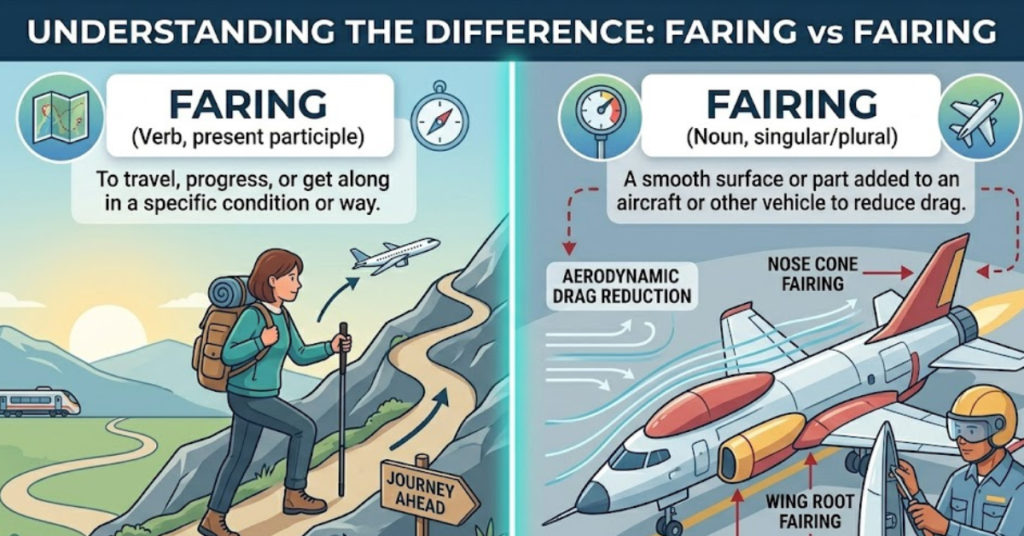
“Faring” comes from the verb fare, which means how someone is doing or progressing in a situation.
Simple meaning:
It describes how well or badly someone is doing.
Common uses:
- Health or condition
- Progress in life or work
- Performance in a situation
Examples:
- How are you faring in your new job?
- She is faring well after the surgery.
- They are faring better than expected in the competition.
In everyday English, faring is mostly used in questions or statements about progress or well-being.
What Does “Fairing” Mean?
Now let’s look at the second part of Faring vs Fairing: fairing.
Unlike “faring,” this word is mainly used in engineering and design.
A fairing is a structure added to vehicles, aircraft, or machines to reduce drag or improve aerodynamics.
Simple meaning:
It is a covering or structure that smooths airflow or improves shape efficiency.
Common uses:
- Aviation (airplanes)
- Motorcycles
- Rockets and spacecraft
Examples:
- The aircraft has a smooth fairing to reduce air resistance.
- The motorcycle fairing improves speed and stability.
- Rocket fairings protect the payload during launch.
So while faring is about progress or condition, fairing is about physical design and structure.
Faring vs Fairing: Key Difference Explained
The main difference in Faring vs Fairing is very clear once you break it down:
- Faring → Describes how someone or something is doing
- Fairing → A physical structure used in engineering for aerodynamics
Easy way to remember:
- Faring = Feeling or doing
- Fairing = Physical object on vehicles
Even though they sound similar, they belong to completely different categories of meaning.
Why People Confuse Faring vs Fairing
The confusion around Faring vs Fairing usually happens because:
- The words sound almost identical when spoken
- Both are spelled similarly
- Autocorrect or typing errors
- Lack of exposure to technical vocabulary
Once you understand their meanings, the confusion disappears quickly.
Real-Life Usage Examples
Let’s make Faring vs Fairing even clearer with real-world examples.
Using “faring” correctly:
- How is your business faring this year?
- The students are faring well in exams.
- She is faring better than last month.
Using “fairing” correctly:
- The airplane fairing reduces wind resistance.
- Engineers redesigned the fairing for better efficiency.
- The rocket fairing protects sensitive equipment.
These examples show how different the two words really are.
Simple Memory Trick
If you struggle with Faring or Fairing, here’s a quick trick:
- Faring = “How are you doing?”
- Fairing = “Physical cover on machines or vehicles”
Think of fairing as something you can see and touch, while faring describes a situation or condition.
FAQs About Faring vs Fairing
1. What is the difference between Faring or Fairing?
“Faring” refers to how someone is doing, while “fairing” refers to a structural part of vehicles or aircraft.
2. Is fairing only used in engineering?
Yes, fairing is mainly used in aviation, automotive, and aerospace contexts.
3. Can faring and fairing be used interchangeably?
No, they have completely different meanings and should not be swapped.
4. What does “faring well” mean?
It means someone is doing well or progressing positively in a situation.
5. Why are Faring or Fairing often confused?
Because they sound similar and have almost identical spellings, leading to frequent mistakes.
Conclusion
Understanding Faring vs Fairing becomes easy once you separate meaning from spelling. One describes how someone or something is doing, while the other refers to a physical structure used in engineering.
The key takeaway is simple: faring is about progress and condition, while fairing is about design and aerodynamics.
Once you remember this difference, you’ll never confuse Faring vs Fairing again—and your writing will instantly become clearer and more accurate.