
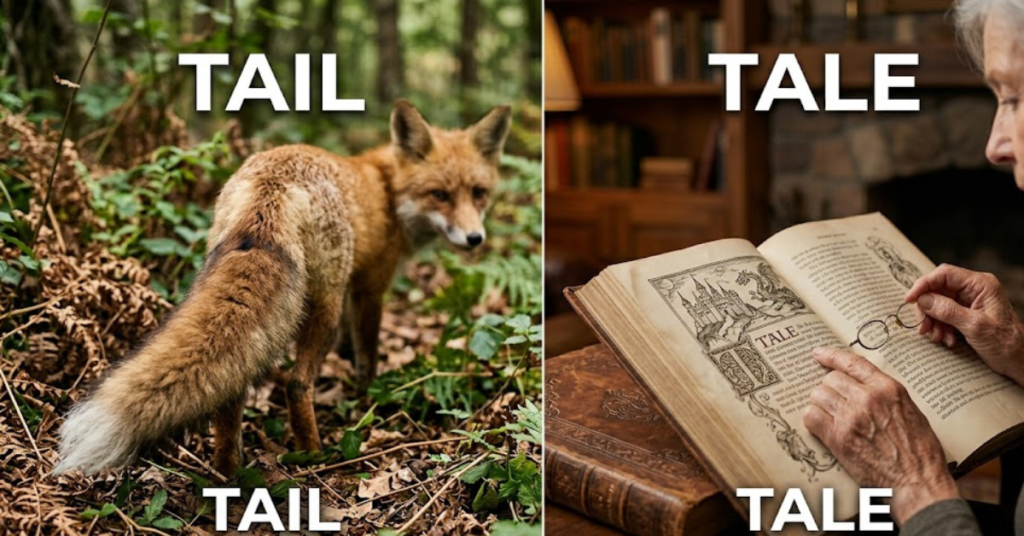

English has many words that sound exactly the same but mean completely different things. One commonly confused pair is tail vs tale. Since both words share identical pronunciation, people often mix them up in writing, even if they understand the meanings when speaking.
Learning the difference between these words is important for clear communication, better spelling, and stronger writing skills. One word relates to animals and physical objects, while the other refers to stories and narratives.
This guide explains tail vs tale pronunciation, meanings, examples, grammar usage, and memory tricks in a simple and practical way.
What Is the Difference Between Tail vs Tale?
The main difference comes down to meaning.
- Tail refers to the rear part of an animal or object.
- Tale refers to a story or narrative.
Although the words sound identical, their uses are completely unrelated.
Tail vs Tale Meaning
Understanding the individual meanings helps make the distinction much clearer.
Meaning of Tail
The word “tail” usually refers to a body part extending from the back of an animal.
Examples:
- The dog wagged its tail.
- The cat’s tail was fluffy.
- The horse flicked its tail.
Tail can also refer to:
- The end part of an object
- The rear section of something
Examples:
- The tail of the airplane
- The tail end of the line
Meaning of Tale
The word “tale” refers to a story, account, or narrative.
Examples:
- She told an exciting tale.
- Fairy tales are popular with children.
- The old sailor shared tales of the sea.
Tale often appears in literature, storytelling, and conversation.
Tail vs Tale Pronunciation
One reason people confuse these words is because tail vs tale pronunciation is exactly the same.
Both words are pronounced:
- /teɪl/
They rhyme with:
- Sail
- Pale
Because they are homophones, context and spelling are the only ways to distinguish them in writing.
How to Use “Tail” Correctly
The word tail can function as both a noun and a verb.
Tail as a Noun
This is the most common usage.
Examples:
- The fox has a bushy tail.
- The kite had a long tail.
- We sat near the tail of the plane.
Tail as a Verb
Sometimes tail means following someone secretly.
Examples:
- Detectives tailed the suspect.
- The reporter tailed the celebrity for hours.
This usage is common in crime stories and detective fiction.
How to Use “Tale” Correctly
Tale is mainly used as a noun.
Tale as a Story
Examples:
- Grandpa told us a funny tale.
- The book contains ancient tales.
- Her tale inspired the audience.
Tale in Literature
The word often appears in:
- Fairy tales
- Folktales
- Adventure tales
- Historical tales
It usually suggests storytelling or imaginative narratives.
Why People Confuse Tail and Tale
Several factors contribute to confusion.
Identical Pronunciation
Since the words sound exactly alike, writing errors happen easily.
Similar Spelling
Only one letter differs between the two words.
Fast Typing and Autocorrect
Quick typing often leads to accidental substitutions.
English Homophones
English contains many homophones that create spelling challenges.
Examples include:
- Mail and male
- Pair and pear
- Plain and plane
Easy Memory Tricks
Simple mental associations can help you remember the correct word.
Remember Tail With Animals
Think:
- Dog tail
- Cat tail
- Fish tail
The word usually relates to physical objects or rear sections.
Remember Tale With Stories
Think:
- Fairy tale
- Bedtime tale
- Adventure tale
The “e” in tale can remind you of entertainment or events in a story.
Common Sentences Using Tail and Tale
Examples make the differences easier to understand.
Tail
- The monkey swung its tail.
- The airplane tail was damaged.
- The comet left a bright tail in the sky.
Tale
- The author wrote a magical tale.
- His tale sounded unbelievable.
- Children enjoy hearing bedtime tales.
Tail vs Tale in Writing
Using the wrong spelling can completely change sentence meaning.
Incorrect:
- “The dog wagged its tale.”
Correct:
- “The dog wagged its tail.”
Incorrect:
- “She told a funny tail.”
Correct:
- “She told a funny tale.”
Proofreading carefully helps avoid these common mistakes.
Common Expressions With Tail
The word tail appears in many English expressions.
Examples:
- Tail end
- Turn tail
- Tail between your legs
- On someone’s tail
These phrases often involve direction, fear, or pursuit.
Common Expressions With Tale
Tale also appears in many familiar expressions.
Examples:
- Fairy tale
- Tall tale
- Tale of survival
- Spin a tale
These expressions relate to storytelling or exaggeration.
Why Context Matters
Since pronunciation cannot distinguish these homophones, context becomes extremely important.
For example:
- “The cat chased its tail” clearly refers to an animal body part.
- “The traveler shared a tale” clearly refers to a story.
Readers rely on surrounding words to determine meaning.
Other Common English Homophones
Tail and tale belong to a larger group of commonly confused English words.
Examples include:
- Steel and steal
- Ring and wring
- Pray and pry
- Pair and pare
Learning these word pairs improves vocabulary and writing accuracy.
FAQs
What is the difference between tail vs tale?
Tail refers to the rear part of an animal or object, while tale means a story or narrative.
Are tail and tale pronounced the same?
Yes. Tail vs tale pronunciation is identical in standard English.
What does tail mean besides an animal body part?
Tail can also refer to the end section of objects, vehicles, lines, or even following someone secretly.
What is a tale in literature?
A tale is a story, often imaginative or entertaining, such as a fairy tale or adventure tale.
How can I remember the difference between tail and tale?
Associate tail with animals and physical objects, and tale with storytelling and books.
Is “fairy tail” correct?
No. The correct phrase is “fairy tale” because it refers to a story.
Conclusion
Understanding tail vs tale becomes much easier once you focus on meaning and context instead of pronunciation alone. Although the words sound exactly alike, they represent completely different ideas in English.
Tail usually refers to the rear part of animals or objects, while tale relates to storytelling and narratives. Paying attention to spelling and sentence context helps prevent common mistakes and improves writing clarity.
Mastering homophones like these strengthens vocabulary, boosts confidence in communication, and makes your writing more polished and professional.