
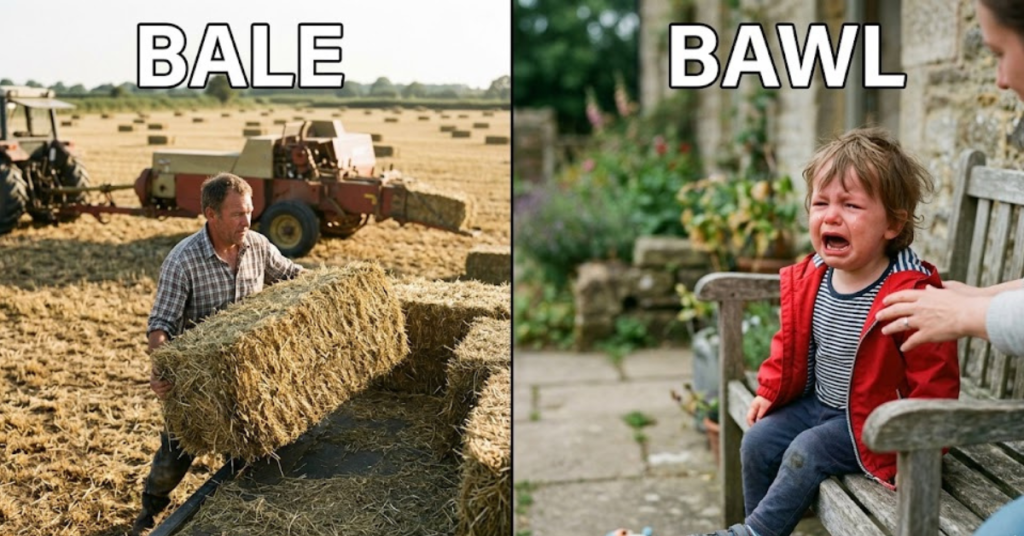

English is full of words that sound exactly alike but have completely different meanings. Bale vs Bawl is one of those classic examples. Since both words are pronounced the same, it’s easy to confuse them in writing, even though they belong to very different contexts.
Understanding Bale vs Bawl can help you avoid common spelling mistakes and improve your writing accuracy. One refers to a bundle of material, while the other describes crying loudly or shouting. Let’s break down the difference in a clear and easy way.
Bale vs Bawl: The Quick Answer
Here’s the simple distinction:
- Bale = A bundle of material tied together, or an old literary word meaning sorrow
- Bawl = To cry loudly or shout in a loud voice
Example:
- Farmers stacked hay into a bale.
- The child began to bawl after falling.
One usually refers to an object, while the other describes an action.
What Does Bale Mean?
Bale is primarily a noun. It most commonly refers to a tightly packed bundle of materials such as hay, cotton, paper, or cloth.
In older literary English, it can also mean sorrow, suffering, or misfortune, though this usage is rare today.
Common meanings of bale:
- A bundle of hay
- A tightly packed package of goods
- A compact mass prepared for storage or transport
- (Rare) sorrow or suffering
Examples:
- The tractor carried a large bale of hay.
- Cotton was packed into a bale for shipping.
- In old poetry, bale could mean grief or suffering.
In modern English, the bundle-related meaning is by far the most common.
What Does Bawl Mean?
Bawl is a verb. It means to cry loudly, sob noisily, or shout in a strong voice.
It often suggests a lack of restraint or a loud emotional outburst.
Common meanings of bawl:
- Cry loudly
- Sob noisily
- Shout in a loud voice
- Call out forcefully
Examples:
- The baby began to bawl in the middle of the night.
- He bawled for help.
- She started to bawl after hearing the news.
This word is almost always connected to sound or emotional expression.
Bale vs Bawl Meaning: What’s the Main Difference?
The easiest way to understand the difference is to look at grammar and meaning.
Bale = Noun (usually)
A physical bundle or package
Bawl = Verb
An action involving loud crying or shouting
Quick comparison:
- A bale of straw sat in the barn.
- The toddler began to bawl loudly.
One names a thing. The other describes an action.
Why People Confuse Bale and Bawl
These words are often confused because they are homophones, meaning they sound exactly alike but have different spellings and meanings.
Pronunciation:
- Bale = BAYL
- Bawl = BAYL
Because pronunciation offers no clue, context becomes very important.
Common Uses of Bale
You’ll usually see bale in farming, manufacturing, shipping, or packaging contexts.
Common phrases:
- Bale of hay
- Bale of cotton
- Straw bale
- Bale for transport
Sentences:
- The farm stored several bales of straw.
- Paper was compressed into a bale for recycling.
Common Uses of Bawl
Bawl is used in emotional or loud speaking situations.
Common phrases:
- Bawl your eyes out
- Bawl with laughter
- Bawl for help
- Bawl loudly
Sentences:
- The child started to bawl uncontrollably.
- Someone bawled across the street.
Common Mistakes in Writing
Because these words sound identical, writers sometimes choose the wrong spelling.
Incorrect:
- The child began to bale after dropping the toy.
Correct:
- The child began to bawl after dropping the toy.
Why? Because the sentence describes loud crying.
Incorrect:
- The farmer loaded a bawl of hay.
Correct:
- The farmer loaded a bale of hay.
Why? Because hay is packed into a bundle.
Memory Tricks to Remember the Difference
A quick memory trick can make these easier to remember.
Trick 1: Bale = Bundle
Think of bale as something you can stack, carry, or store.
Trick 2: Bawl = Loud cry
The “aw” in bawl can remind you of a loud “awww!” sound when someone cries.
This small association can help you choose the correct spelling.
Bale vs Bawl in Context
Context makes the correct word much easier to identify.
Use bale when talking about:
- Hay
- Cotton
- Bundles
- Packaging
- Storage
Use bawl when talking about:
- Crying
- Shouting
- Loud emotions
- Calling out
If the sentence involves sound, bawl is usually correct. If it involves a bundle, bale is the right choice.
FAQs
What is the difference between bale and bawl?
Bale usually refers to a bundle of material, while bawl means to cry loudly or shout.
Is bale a verb?
In some contexts, yes, such as baling hay, but it is most commonly used as a noun.
What does bawl mean?
Bawl means to cry noisily, sob loudly, or shout.
Are bale and bawl pronounced the same?
Yes. They are homophones and share the same pronunciation.
What is a bale of hay?
A bale of hay is a tightly packed bundle of hay prepared for storage, transport, or feeding animals.
Can bawl mean shouting?
Yes. It can refer to shouting loudly as well as crying.
Conclusion
Understanding Bale vs Bawl is simple once you focus on meaning and context. Bale usually refers to a bundle of material, especially in farming or packaging. Bawl is a verb that describes loud crying or shouting.
The next time you see these words, ask yourself: Are you talking about a bundle or a loud sound? That quick check can help you choose the correct spelling and make your writing more accurate and polished.