
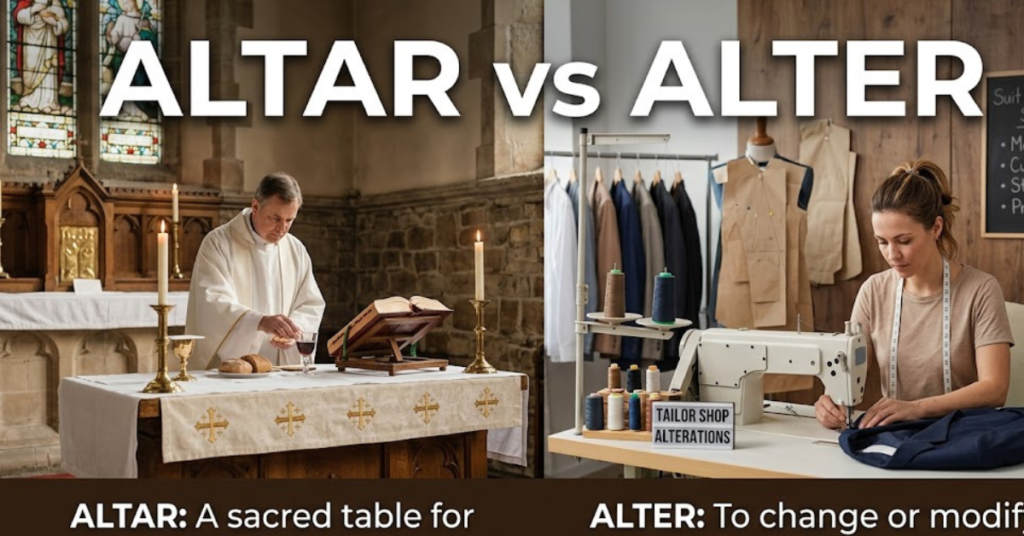

English is full of words that sound alike but mean completely different things, and Altar vs Alter is a perfect example. Since both words are pronounced the same, many writers accidentally use one when they really mean the other.
Understanding the altar vs alter meaning is actually quite simple once you know what each word does in a sentence. One is a noun connected to religion and ceremonies, while the other is a verb that means to change something. Let’s break down the altar vs alter difference clearly so you can use each word correctly every time.
Altar vs Alter: The Quick Answer
Here’s the simple difference:
- Altar = A table or structure used in religious ceremonies
- Alter = To change, modify, or make something different
Example:
- The couple stood before the altar during the wedding.
- He decided to alter his travel plans.
One is a thing, while the other is an action.
What Does Altar Mean?
Altar is a noun. It refers to a raised table, platform, or sacred structure used in religious worship, ceremonies, or rituals.
It is commonly associated with churches, temples, weddings, and spiritual practices.
Common uses of altar:
- Religious worship
- Wedding ceremonies
- Sacred rituals
- Prayer offerings
- Spiritual symbolism
Examples:
- Flowers decorated the church altar.
- The bride and groom stood at the altar.
- Candles were placed on the altar during the ceremony.
In each example, the word refers to a physical sacred place or ceremonial structure.
What Does Alter Mean?
Alter is a verb. It means to change, adjust, modify, or make something different.
This word is used in everyday English and can apply to physical objects, plans, behavior, ideas, or situations.
Common meanings of alter:
- Change something
- Modify details
- Adjust a plan
- Transform appearance
- Make something different
Examples:
- They had to alter the design.
- The tailor will alter the dress.
- Nothing can alter the outcome now.
Unlike altar, this word is an action.
Altar vs Alter Meaning: What’s the Core Difference?
The easiest way to understand the altar vs alter meaning is to look at grammar.
Altar = Noun
A place or structure used in religious ceremonies
Alter = Verb
An action meaning to change something
This grammatical difference makes the words much easier to separate.
Quick comparison:
- She walked toward the altar.
- They decided to alter the agreement.
One names something. The other describes an action.
Altar vs Alter Difference in Real-Life Usage
These words are often confused because they sound exactly alike.
However, their meanings are completely unrelated.
Use altar when talking about:
- Churches
- Weddings
- Religion
- Ceremonies
- Sacred spaces
Use alter when talking about:
- Changes
- Adjustments
- Modifications
- Revisions
- Transformations
This simple context clue helps avoid mistakes.
Why Do People Confuse Altar and Alter?
The main reason is pronunciation.
Pronunciation:
- Altar = “awl-ter”
- Alter = “awl-ter”
Since they sound the same, they are homophones—words with identical pronunciation but different meanings and spellings.
Because sound doesn’t help, spelling depends entirely on context.
Common Mistakes in Writing
These words often get mixed up in writing.
Incorrect:
- The bride walked toward the alter.
Correct:
- The bride walked toward the altar.
Why? Because weddings involve a ceremonial structure, not a change.
Incorrect:
- We need to altar the schedule.
Correct:
- We need to alter the schedule.
Why? Because the sentence is about changing something.
Memory Tricks to Remember the Difference
A quick memory trick can make these homophones easier to remember.
Trick 1: Altar = Ceremony
Think of weddings and churches.
- Altar has an “a” like at church altar
Trick 2: Alter = Change
Think of “alteration.”
- Alter = to modify or adjust
This is especially helpful because the word alteration comes directly from alter.
Altar in Common Expressions
Some phrases use altar in symbolic or traditional ways.
Examples:
- At the altar
- Lead someone to the altar
- Sacrifice on the altar of success
These expressions often come from religious or ceremonial imagery.
Alter in Common Expressions
Alter appears in many everyday contexts.
Examples:
- Alter your plans
- Alter your appearance
- Alter the outcome
- Alter a document
- Alter behavior
Because it means “change,” it has broad use in everyday speech.
Related Commonly Confused Words
If you confuse these words, you may also struggle with:
- Aisle vs Isle
- Their vs There vs They’re
- Affect vs Effect
- Principal vs Principle
- Compliment vs Complement
English homophones often create spelling mistakes because pronunciation can be misleading.
FAQs
What is the difference between altar and alter?
Altar is a noun referring to a religious or ceremonial structure, while alter is a verb meaning to change something.
Is altar a verb?
No, altar is a noun.
Is alter used in weddings?
Not in the ceremonial sense. In wedding ceremonies, the correct word is altar.
What does alter mean?
Alter means to change, adjust, or modify something.
Why do people confuse altar and alter?
Because they are pronounced the same, many people accidentally choose the wrong spelling.
What is an altar used for?
An altar is used in religious ceremonies, worship, rituals, and wedding ceremonies.
Conclusion
Understanding Altar vs Alter becomes easy once you remember the key distinction: altar is a noun referring to a ceremonial or religious structure, while alter is a verb that means to change something.
The next time you use one of these words, think about the sentence. Are you talking about a sacred place, or are you talking about making a change? That quick check can help you avoid a common spelling mistake and make your writing more precise and professional.