
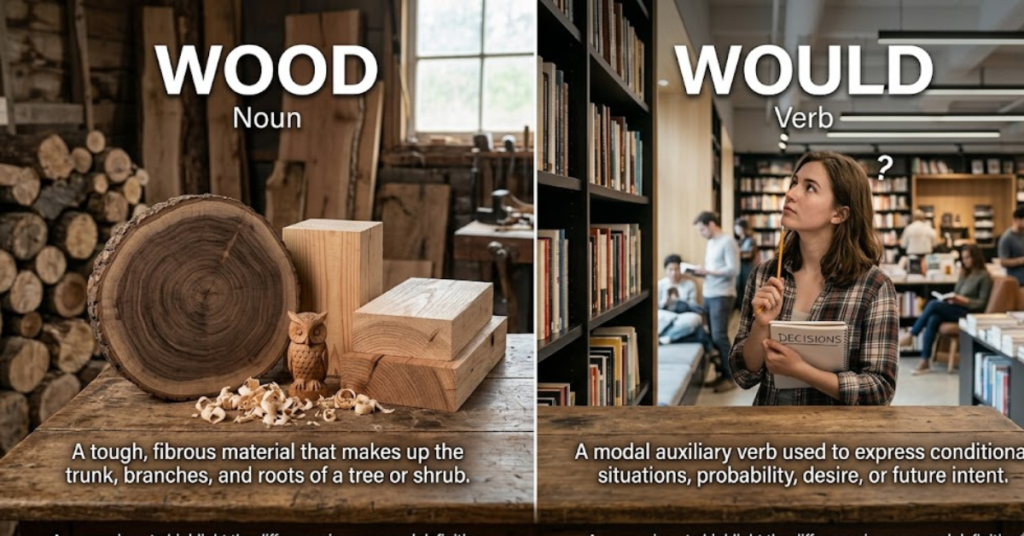

English is full of words that confuse learners simply because they sound similar but mean completely different things. One such tricky pair is wood vs would. At first glance, they seem related, but in reality, they belong to entirely different categories in grammar and meaning.
Understanding the difference is important because mixing them up can completely change a sentence. One word refers to a natural material from trees, while the other is a modal verb used to express possibility, politeness, or hypothetical situations.
This guide breaks down wood vs would in a simple, clear, and practical way so you can confidently use both words in writing and speech.
What Is the Difference Between Wood vs Would?
The main difference lies in meaning and grammar function.
- Wood refers to the material from trees used for building or burning.
- Would is a modal verb used to express possibility, politeness, or imagined situations.
Even though they sound similar in some accents, their usage is completely unrelated.
Meaning of Wood
The word “wood” refers to a natural material that comes from trees.
Wood as a Material
Wood is widely used in:
- Furniture
- Construction
- Tools
- Paper production
- Fuel
Examples:
- The table is made of wood.
- They built a house using wood.
- Wood burns easily in a fire.
Wood as a Forest Area
Wood can also refer to a small forested area.
Examples:
- They walked through the woods.
- The cabin is located near the wood.
Meaning of Would
The word “would” is a modal verb used in many different grammatical situations.
Would for Hypothetical Situations
Examples:
- I would travel if I had money.
- She would help if she could.
- They would move abroad in the future.
Would for Politeness
Examples:
- Would you like some tea?
- I would appreciate your help.
- Would you please sit down?
Would in Past Habit
Examples:
- He would visit his grandparents every summer.
- She would always read before bed.
Wood vs Would Pronunciation
One of the main reasons for confusion is wood vs would pronunciation.
In most accents of English, both words are pronounced:
- /wʊd/
Because they are homophones, listeners cannot distinguish them without context.
How to Use “Wood” Correctly
Wood is a noun used in physical or natural contexts.
Common Uses of Wood
Examples:
- The chair is carved from wood.
- Wood is a renewable resource.
- We collected wood for the campfire.
Wood in Everyday Life
Wood is commonly associated with:
- Furniture making
- Construction materials
- Natural environments
How to Use “Would” Correctly
Would is a helping verb used in sentences that involve conditions, politeness, or imagination.
Would in Conditional Sentences
Examples:
- I would go if I were free.
- She would buy it if it were cheaper.
Would in Requests
Examples:
- Would you help me?
- Would you open the door?
Would in Repeated Past Actions
Examples:
- He would always arrive early.
- They would play outside every evening.
Why People Confuse Wood and Would
Several reasons make these words confusing.
Similar Sound in Speech
In most English accents, both words sound identical.
Fast Conversation
In spoken English, listeners rely on context instead of pronunciation.
Typing Errors
Since the words differ by only one letter, typing mistakes are very common.
Easy Memory Tricks
Simple techniques can help you remember the difference quickly.
Remember Wood = Tree Material
Think:
- Trees
- Furniture
- Forest
Wood always comes from nature.
Remember Would = Conditional Word
Think:
- “Would if”
- “Would like”
- “Would you”
Would is always used in imagined or polite situations.
Common Examples Using Wood and Would
Seeing real examples makes the difference clearer.
Examples With Wood
- The floor is made of wood.
- We gathered wood for the fire.
- The cabin is deep in the woods.
Examples With Would
- I would go with you tomorrow.
- Would you like some water?
- She would always smile at us.
Common Grammar Mistakes
Mixing these words can completely change meaning.
Incorrect:
- “I wood like some tea.”
Correct:
- “I would like some tea.”
Incorrect:
- “The table is made of would.”
Correct:
- “The table is made of wood.”
Even small spelling mistakes can confuse readers.
Wood vs Would in Writing
These words often appear in both casual and formal writing, so accuracy is important.
Wood in Writing
Used in:
- Environmental topics
- Construction descriptions
- Product details
Example:
- The house features natural wood interiors.
Would in Writing
Used in:
- Essays
- Formal requests
- Hypothetical statements
Example:
- I would recommend this solution.
Why Context Matters
Because wood vs would pronunciation is identical, context becomes the only clue.
For example:
- “The chair is made of wood” clearly refers to material.
- “I would like to join” clearly refers to intention or politeness.
The sentence structure makes the meaning obvious.
FAQs
What is the difference between wood vs would?
Wood is a natural material from trees, while would is a modal verb used for politeness, conditions, or imagination.
Are wood and would pronounced the same?
Yes. In most English accents, they are both pronounced /wʊd/.
What does wood mean?
Wood refers to the material from trees used for building, furniture, and fuel.
What does would mean in grammar?
Would is used to express possibility, polite requests, or hypothetical situations.
How can I remember wood vs would?
Think wood = trees and nature, and would = “if” situations or polite requests.
Is “I wood like” correct?
No. The correct form is “I would like.”
Conclusion
Understanding wood vs would becomes easy once you focus on meaning instead of pronunciation. Although these words sound identical in spoken English, they serve completely different purposes in writing and communication.
Wood refers to a natural material from trees, while would is a grammar helper used for politeness, imagination, and conditional situations. With practice and attention to context, you can avoid common mistakes and use both words correctly.
Mastering confusing word pairs like these improves grammar accuracy, strengthens writing skills, and builds confidence in everyday English communication.