
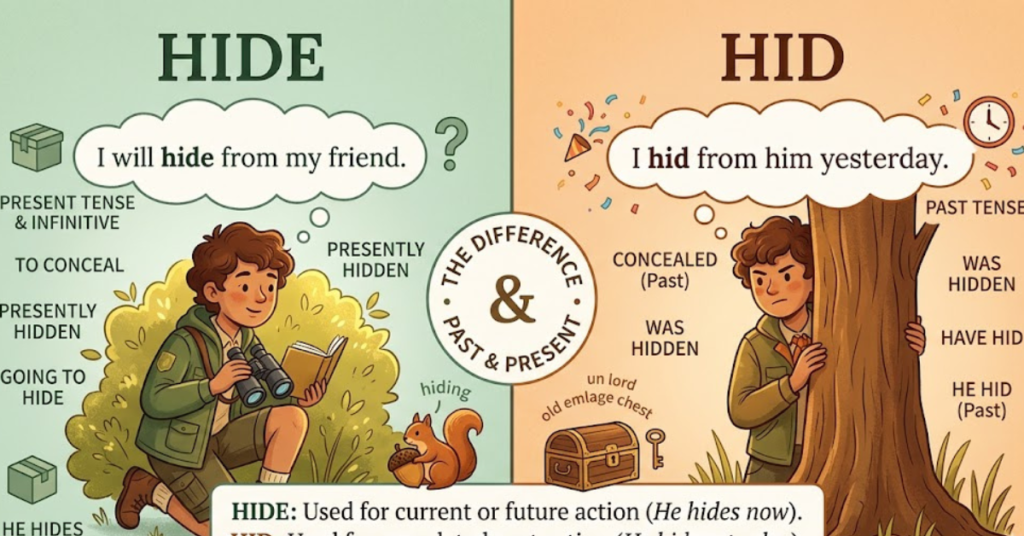

If you’ve ever stopped mid-sentence wondering about hide or hid, you’re dealing with one of the most common verb tense confusions in English. These two forms look simple, but they belong to different grammatical categories, which is why learners often mix them up.
This guide breaks everything down in a clear and practical way so you can use them correctly in everyday writing and speech.
Meaning Explained
Before comparing usage, it helps to understand the verb itself.
What Does “Hide” Mean?
“Hide” is the base form of the verb. It means:
- To put something out of sight
- To conceal something or someone
- To keep something secret or private
What Does “Hid” Mean?
“Hid” is the past tense form. It refers to:
- An action that already happened
- Something that was concealed in the past
So the difference is not meaning, but timing.
Grammar Difference
Understanding grammar makes the distinction much clearer.
Present Form: Hide
Use “hide” when talking about:
- Current actions
- Habitual behavior
- General statements
Examples:
- I hide my diary under the bed.
- They hide during the game.
Past Form: Hid
Use “hid” for completed actions in the past.
Examples:
- I hid the gift yesterday.
- She hid behind the door.
What About “Have Hid”?
This is where many learners get confused.
The correct form is actually “have hidden,” not “have hid.”
Verb Forms of Hide
- Base form: hide
- Past tense: hid
- Past participle: hidden
So after “have / has / had,” the correct word is always hidden.
Correct:
- I have hidden the book.
Incorrect:
- I have hid the book.
Usage in Sentences
Present Tense
- I hide my phone during meetings.
- Children hide when playing tag.
Past Tense
- He hid the money in a safe place.
- They hid from the storm.
Perfect Tense
- She has hidden the keys somewhere.
- I had hidden the documents earlier.
Common Mistakes
Many learners struggle with similar errors:
- Using past form in present tense
- Confusing “hid” with “hidden”
- Mixing verb forms in perfect tenses
- Overusing base form incorrectly
Easy Way to Remember
A simple rule helps avoid confusion:
Think Time-Based Forms
- Hide → present or general action
- Hid → past action
- Hidden → completed action with “have/has/had”
This makes choosing the correct form much easier.
Why This Confusion Happens
This mistake is common because:
- English has irregular verbs
- The forms look very similar
- Learners mix tense rules
- Lack of repeated practice
Once you recognize the pattern, it becomes much easier to remember.
FAQs
What is the difference between them?
One is present tense, the other is past tense.
What is the correct past participle?
The correct form is “hidden.”
Is “have hid” correct?
No, the correct form is “have hidden.”
When do we use the past form?
We use it for actions that already happened.
Can the base form be used in past tense?
No, the past tense is “hid.”
Conclusion
The difference is simple once you focus on grammar rules: one form is for present actions, one for past actions, and another for perfect tenses.
Understanding these patterns helps you avoid common mistakes and use the verb naturally in both writing and speech. With practice, choosing the correct form becomes automatic.