
English grammar can be confusing, especially when it comes to phrases like if I was vs if I were. Many people use them interchangeably, but they are not always correct in the same context.
Understanding the difference between if I was vs if I were is important for speaking and writing clearly, especially in formal English. The good news is that once you learn the simple rule behind it, you’ll never mix them up again.
Let’s break it down in a simple, conversational way.
If I Was vs If I Were: Basic Difference
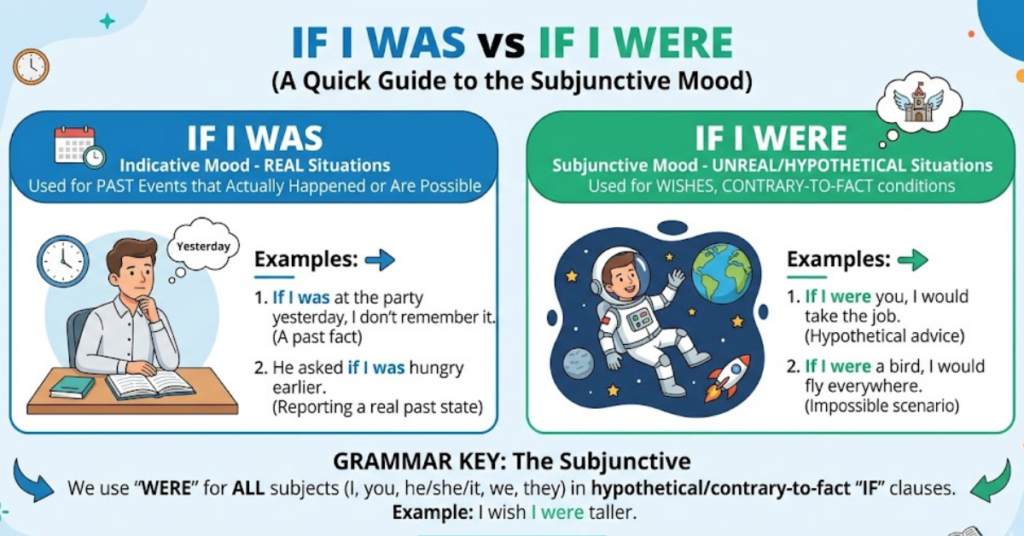
The main difference between if I was vs if I were lies in grammar mood:
- “If I was” → used for real situations (past events that likely happened)
- “If I were” → used for imaginary or unreal situations (subjunctive mood)
In simple terms:
- “If I was” = something that could be true
- “If I were” = something that is not real or hypothetical
This is the core if i was vs if i were difference every learner should understand.
Grammar If I Was vs If I Were Explained
Let’s look deeper into grammar if i was vs if i were with examples.
If I Was (Real or Possible Situations)
Use “if I was” when you are unsure or talking about something that may have actually happened.
Examples:
- If I was rude yesterday, I apologize.
- If I was late, it was بسبب traffic.
Here, the action might be real or possible.
If I Were (Imaginary or Hypothetical Situations)
Use “if I were” when talking about unreal or imagined situations.
Examples:
- If I were a bird, I would fly across the world.
- If I were rich, I would travel everywhere.
This is the classic subjunctive mood in English.
If I Was vs If I Were Difference in Simple Words
To make it even easier:
- If I was → past reality, unsure truth
- If I were → imagination, dreams, or impossible situations
This is why you’ll often see “if I were” in poetry, wishes, and storytelling.
Merriam-Webster If I Was vs If I Were Explanation
According to standard grammar references like Merriam-Webster, “if I were” is traditionally used for hypothetical situations, even when talking about yourself.
However, modern English has become more flexible, and “if I was” is often used in casual speech.
Still, in formal writing:
- “If I were” is preferred for imaginary statements
- “If I was” is acceptable for real or uncertain past actions
This balance helps explain how English evolves over time.
When to Use If I Was
Use “if I was” in these situations:
- You are not sure about a past event
- You are referring to something that might be true
- You are speaking casually
Examples:
- If I was unclear, let me explain again.
- If I was there, I don’t remember it well.
When to Use If I Were
Use “if I were” in:
- Imaginary situations
- Wishes or dreams
- Unreal conditions
Examples:
- If I were you, I would take the opportunity.
- If I were a millionaire, I would donate to charity.
This form sounds more formal and grammatically traditional.
Common Mistakes with If I Was vs If I Were
Many learners mix these up. Here are common errors:
- If I was you, I would go.
If I were you, I would go. - If I were late yesterday, I’m sorry.
If I was late yesterday, I’m sorry.
A simple rule:
If it’s imaginary → use “were”
If it’s real or unsure → use “was”
Quick Memory Trick
Here’s an easy way to remember:
- “Was = real past”
- “Were = wish or unreal world”
This trick helps avoid confusion in most cases.
FAQs on If I Was vs If I Were
1. What is the difference between if I was vs if I were?
“If I was” refers to real or possible situations, while “if I were” is used for imaginary or unreal situations.
2. Is “if I was you” correct?
No, grammatically it should be “if I were you” because it is a hypothetical situation.
3. Why do people still say “if I was”?
In modern English, casual speech often ignores strict grammar rules, making “if I was” common in informal use.
4. What does Merriam-Webster say about if I was vs if I were?
Merriam-Webster explains that “if I were” is traditionally correct for hypotheticals, while “if I was” can be used in real past contexts.
5. Which is more correct in formal writing?
“If I were” is preferred in formal writing, especially for imaginary or unreal situations.
Conclusion
Understanding if I was vs if I were helps you speak and write English more confidently. The key is simple: use “was” for real or uncertain past situations and “were” for imaginary or hypothetical ones.
Once you master this rule, your grammar instantly becomes more polished and natural. Keep practicing with real examples, and soon it will feel effortless in both writing and conversation.