
You’ve probably seen both infact and in fact used online—but which one is actually correct? The confusion around infact or in fact is more common than you might think, especially in fast-paced digital writing.
In this guide, we’ll break down is it infact or in fact, explain the correct spelling, and show you how to use it properly in everyday sentences. Whether you’re writing an email, blog, or academic paper, getting this right can instantly improve your clarity and credibility.
Infact or In Fact Meaning
Let’s clear up the confusion right away.
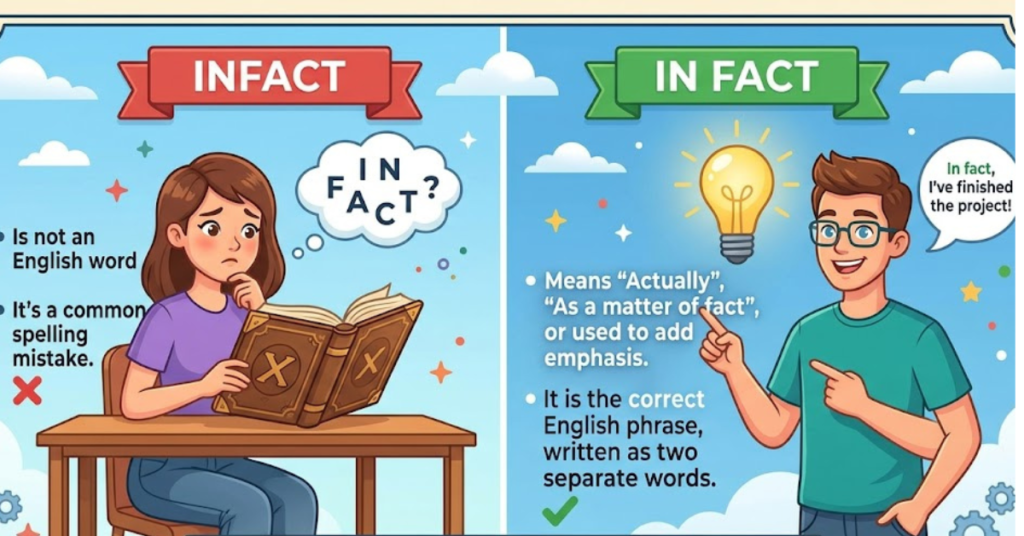
- In fact is the correct phrase.
- Infact is not a standard English word.
What Does “In Fact” Mean?
The phrase in fact is used to:
- Emphasize a statement
- Introduce additional information
- Clarify or correct something
Examples:
- She didn’t dislike the movie; in fact, she loved it.
- He’s not new here. In fact, he’s been working for years.
So when thinking about infact or in fact meaning, remember that only in fact carries real meaning in proper English.
Is It Infact or In Fact?
This is one of the most searched grammar questions: is it infact or in fact?
The Correct Answer
- Always use in fact (two words)
- Avoid infact in all formal and informal writing
Why “Infact” Is Incorrect
Infact usually appears due to:
- Typing too quickly
- Misunderstanding spacing rules
- Influence from informal online writing
Even though you might see infact on social media, it’s still considered incorrect in proper grammar.
Infact or In Fact Spelling Rules
Spelling plays a key role in clear communication. Here’s how to remember it easily.
Correct Spelling Tips
- In fact is a two-word phrase
- Both words should always be separated
- It functions as a connector or emphasis phrase
Quick Memory Trick
Think of in fact as similar to:
- In time
- In place
- In case
All of these are two words—so in fact follows the same pattern.
Infact or In Fact Examples in Sentences
Seeing real examples can make the difference stick.
Correct Usage
- I thought it would be difficult. In fact, it was quite easy.
- She isn’t tired. In fact, she’s full of energy.
- The product is popular; in fact, it’s sold out.
Incorrect Usage
- I like it, infact I love it.
- He didn’t call me, infact he ignored me.
Whenever you’re unsure, go with in fact.
Infact or In Fact UK and Global Usage
You might wonder if there’s a regional difference, especially in British English.
Is It Different in the UK?
No—there’s no variation here.
- In both American and British English, in fact is correct
- Infact is incorrect everywhere
So if you’re asking about infact or in fact UK, the rule stays the same globally.
Infact or In Fact Synonym Options
Sometimes you may want variety in your writing. Here are some alternatives to in fact:
Common Synonyms
- Actually
- Indeed
- As a matter of fact
- Truly
- Really
Example Substitutions
- In fact, she was right.
→ Actually, she was right. - He didn’t fail; in fact, he succeeded.
→ He didn’t fail; indeed, he succeeded.
Using synonyms can improve flow and prevent repetition.
Why Getting This Right Matters
It might seem like a small detail, but using the correct form has real impact.
Benefits of Correct Usage
- Improves writing clarity
- Enhances professionalism
- Builds trust with readers
- Avoids grammar mistakes
In professional or academic settings, even minor errors like infact can make your writing look careless.
FAQs
1. Is “infact” ever correct?
No, infact is not recognized as a correct word in standard English.
2. Why do people write “infact”?
It’s usually due to typing errors or misunderstanding that in fact should be two separate words.
3. Can I use “in fact” at the beginning of a sentence?
Yes, you can. Example: In fact, this is the best option available.
4. What part of speech is “in fact”?
It’s a phrase used as a discourse marker or adverbial expression to add emphasis or clarification.
5. Are there alternatives to “in fact”?
Yes, you can use words like actually, indeed, or as a matter of fact depending on the context.
Conclusion
When it comes to infact or in fact, the answer is clear: in fact is the correct and accepted form, while infact is simply a common mistake. Understanding this difference helps you write more clearly and professionally.
To sum it up:
- Always use in fact as two separate words
- Avoid infact in all types of writing
- Use synonyms when you want variation
Small grammar fixes like this can make a big difference in how your writing is perceived. Keep learning, stay curious, and continue refining your language skills for better communication.