
Have you ever typed oversite and wondered if it’s correct—or just a typo for oversight? You’re not alone. The confusion around oversite vs oversight is surprisingly common, especially in professional writing and discussions about supervision or management.
In this article, we’ll break down the oversite vs oversight meaning, explore how each term is used, and give you clear examples so you can avoid mistakes. By the end, you’ll not only understand the difference but also know exactly when to use the right word with confidence.
Oversite vs Oversight Meaning
Let’s get straight to the point:
- Oversight is a real and widely accepted word.
- Oversite is usually a misspelling or typo of oversight.
What Does “Oversight” Mean?
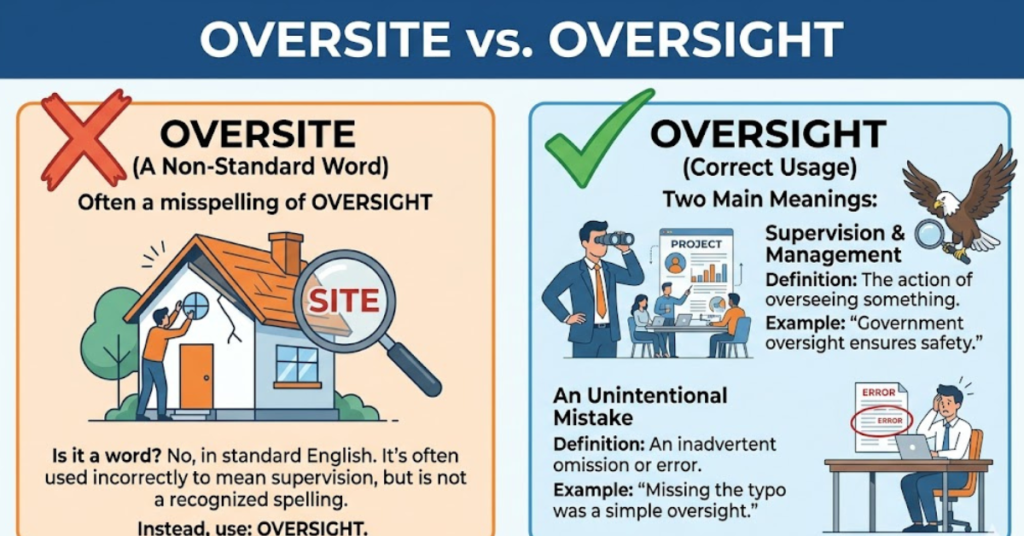
The word oversight has two main meanings:
- Supervision or management
- Example: The manager has oversight of the entire project.
- An unintentional mistake
- Example: Forgetting to attach the file was an oversight.
This dual meaning can sometimes confuse learners, but context usually makes it clear.
Is “Oversite” a Real Word?
Technically, oversite is not recognized in standard English dictionaries as a correct alternative to oversight. In most cases, it appears due to:
- Typographical errors
- Misunderstanding of spelling
- Informal or incorrect usage online
So when comparing oversite vs oversight, the correct choice in almost every situation is oversight.
Oversite vs Oversight Supervision Context
One of the most common areas where people get confused is in professional or corporate language.
Correct Usage in Supervision
When talking about leadership, governance, or monitoring:
- Always use oversight
- Never use oversite
Examples:
- The board provides oversight of company operations.
- Government agencies ensure regulatory oversight.
Using oversite in these contexts can make your writing look unprofessional or incorrect.
Why This Matters
In business, legal, or academic writing, precision is everything. A small spelling error like this can:
- Reduce credibility
- Cause confusion
- Signal lack of attention to detail
Oversite vs Oversight Examples
Let’s make things clearer with practical examples.
Correct Examples with “Oversight”
- The project failed due to a minor oversight in planning.
- She was given oversight of the new department.
- Financial oversight is essential for long-term success.
Incorrect Examples with “Oversite”
- The manager has oversite of the team.
- This was just an oversite in the report.
In each case above, oversight should be used instead.
Oversite vs Oversight Verb Usage
Here’s another important distinction: neither oversite nor oversight functions as a verb.
What to Use Instead
If you want a verb form, use alternatives like:
- Oversee (the correct verb)
- Example: She oversees daily operations.
- Supervise
- Example: He supervises the staff.
Key Takeaway
- Oversight = noun
- Oversee = verb
- Oversite = incorrect spelling
Common Reasons for Confusion
Understanding why people mix these terms can help you avoid the mistake.
1. Similar Sound
Both words sound almost identical when spoken, which leads to spelling errors.
2. Typing Errors
Fast typing or autocorrect can easily turn oversight into oversite.
3. Lack of Awareness
Many people assume both spellings are acceptable, which isn’t the case.
Quick Tips to Remember the Difference
Keep these simple tricks in mind:
- Think of “sight” in oversight as “seeing” or “watching” → supervision
- Remember that oversight is the only correct form
- If you mean “to supervise,” use oversee, not oversight
FAQs
1. Is “oversite” ever correct?
No, oversite is generally considered a misspelling of oversight and should be avoided in formal writing.
2. What is the difference between oversight and supervise?
- Oversight is a noun (the act of supervising)
- Supervise is a verb (the action itself)
3. Can oversight mean a mistake?
Yes, oversight can also mean an unintentional error or omission, depending on context.
4. How do you use oversight in a sentence?
Example: The committee has oversight of all financial decisions.
5. What is the verb form of oversight?
The verb form is oversee, not oversight or oversite.
Conclusion
The debate around oversite vs oversight is simpler than it first appears. Oversight is the correct and accepted term, whether you’re talking about supervision or a minor mistake. Oversite, on the other hand, is almost always an error that should be corrected.
To write clearly and professionally:
- Use oversight for supervision or errors
- Use oversee when you need a verb
- Avoid oversite altogether
Mastering small distinctions like this can make a big difference in how polished and credible your writing feels. If you found this helpful, consider exploring other commonly confused words to sharpen your language skills even further.