
English has a funny way of tripping people up with words that look almost identical but mean completely different things. One of the most confusing pairs is “redact vs retract.” At first glance, they seem interchangeable, but in reality, they belong to completely different worlds of meaning.
If you’ve ever hesitated while writing an email, report, or article, wondering which word fits, you’re not alone. Even experienced writers sometimes pause at these two.
Let’s break it down in a simple, practical way so you never confuse them again.
Redact vs Retract Meaning Explained
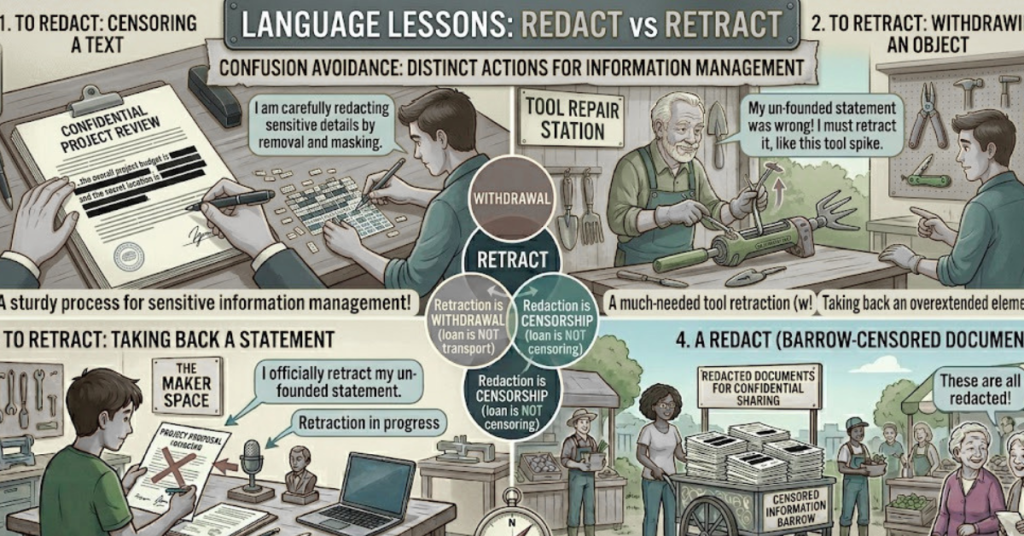
The simplest way to understand redact vs retract is to focus on what is being changed.
- “Retract” means to take something back, usually a statement or claim.
- “Redact” means to remove or hide sensitive information from a document.
Both involve “removal,” but the purpose and context are completely different.
What Does “Retract” Mean?
“Retract” is a verb used when someone withdraws something they previously said, wrote, or claimed.
It often applies to:
- statements
- opinions
- accusations
- announcements
- reports
Simple Definition
Retract = to take back something said or published
Examples of “Retract”
- The journalist retracted the incorrect report.
- He retracted his statement after realizing the mistake.
- The company retracted its earlier announcement.
In each case, the idea or statement is completely withdrawn.
What Does “Redact” Mean?
“Redact” is also a verb, but it is used in a completely different context. It refers to editing a document by removing or hiding sensitive information before it is shared publicly.
This is very common in:
- legal documents
- government reports
- police records
- classified files
- confidential paperwork
Simple Definition
Redact = to censor or hide sensitive parts of a document
Examples of “Redact”
- The lawyer redacted personal details from the contract.
- Names were redacted for privacy reasons.
- Sensitive information was redacted before publication.
Here, the content is not removed entirely—only specific parts are hidden.
The Key Difference Between Redact and Retract
Understanding redact vs retract becomes easy when you focus on intent:
Retract
- Takes back a statement completely
- Used in speech, writing, or claims
- Common in media and communication
Redact
- Hides or removes parts of a document
- Used in legal, government, and official texts
- Focuses on privacy and confidentiality
One is about correcting or withdrawing information, while the other is about protecting sensitive content.
Why People Confuse These Words
It’s easy to see why people mix them up:
1. Similar Spelling
Both words:
- start with “re”
- end with “act”
- look visually similar
2. Formal Contexts
They both appear in serious writing like:
- journalism
- law
- official reports
3. Overlapping Idea of “Removal”
Both involve removing something, but in very different ways.
Real-Life Examples of “Retract”
Let’s look at how “retract” is used in everyday situations.
Media and Journalism
- The newspaper retracted the misleading headline.
- The reporter retracted the false claim.
Business Communication
- The CEO retracted the earlier statement about layoffs.
- The company retracted its pricing announcement.
Personal Communication
- I need to retract what I said earlier.
- She retracted her comment after the discussion.
Real-Life Examples of “Redact”
Now let’s see “redact” in action.
Legal Use
- Lawyers redacted sensitive evidence before court submission.
- The document was heavily redacted for privacy.
Government Use
- The report was released with redacted sections.
- Officials redacted classified information.
Workplace Use
- HR redacted employee details from the file.
- Financial records were redacted before sharing.
Redact vs Retract in Simple Grammar Terms
Here’s a quick breakdown of how each word behaves in sentences:
Retract (Verb Forms)
- retract
- retracts
- retracted
- retracting
Example:
- The author is retracting the article.
Redact (Verb Forms)
- redact
- redacts
- redacted
- redacting
Example:
- The agency is redacting confidential details.
Easy Trick to Remember the Difference
A simple memory trick can save you from confusion:
Retract = Take Back
Think:
- “retract” = return or withdraw a statement
Redact = Black Out
Think:
- “redact” = redact = redact = redact (like blacked-out text in documents)
Visualizing black marker lines over text makes “redact” easy to remember.
Common Mistakes to Avoid
Even good writers mix these up sometimes.
Incorrect Usage
- The lawyer retracted personal details from the file.
- The company redacted its apology.
Correct Usage
- The lawyer redacted personal details from the file.
- The company retracted its apology.
The key is understanding context, not just spelling.
When to Use “Retract”
Use “retract” when:
- taking back a statement
- correcting misinformation
- withdrawing a claim or opinion
Examples:
- retract an accusation
- retract a statement
- retract a promise
When to Use “Redact”
Use “redact” when:
- hiding sensitive information
- censoring documents
- protecting privacy
Examples:
- redact names
- redact addresses
- redact confidential data
Why This Distinction Matters
Using the wrong word can completely change meaning, especially in professional writing.
Clear vocabulary is important because it:
- improves credibility
- avoids confusion
- enhances professionalism
- ensures accurate communication
This is especially critical in legal, academic, and journalistic writing.
Quick Summary
To make it super simple:
- Retract = take back a statement
- Redact = hide sensitive information
Once you remember this, the confusion disappears quickly.
FAQs
What is the difference between redact vs retract?
“Retract” means to take back something said, while “redact” means to hide or censor parts of a document.
Is redact used in legal writing?
Yes, “redact” is commonly used in legal and government documents to protect sensitive information.
What does retract mean in journalism?
It means officially withdrawing or correcting a published statement or report.
Can a document be retracted?
Yes, but it is more common for statements or articles to be retracted rather than documents.
Why do people confuse redact and retract?
They look and sound similar and both involve removing something, but in very different ways.
Which word is related to privacy?
“Redact” is used when dealing with privacy and confidential information.
Is it correct to say “retract information from a document”?
No, the correct word in that context is “redact.”
Conclusion
Understanding redact vs retract becomes simple once you focus on context rather than spelling. “Retract” is about taking back statements or claims, while “redact” is about hiding sensitive information in documents.
Although they look similar, their meanings serve completely different purposes in communication. Using the right word improves clarity, professionalism, and accuracy in writing.
If you want to strengthen your grammar skills further, learning more commonly confused word pairs like this can make your English more precise, confident, and effective in everyday use.