
Ever wondered why words like disagree, dislike, or disconnect all seem to have a similar beginning? That little part at the start—“dis”—actually carries a powerful meaning that changes the whole word.
Understanding what does the prefix dis mean can make English vocabulary much easier to learn, especially for students, beginners, and anyone trying to improve their language skills. Once you understand it, you’ll start recognizing it everywhere in reading, writing, and everyday conversation.
Let’s break it down in a simple, friendly way so it actually sticks.
What Does the Prefix Dis Mean?
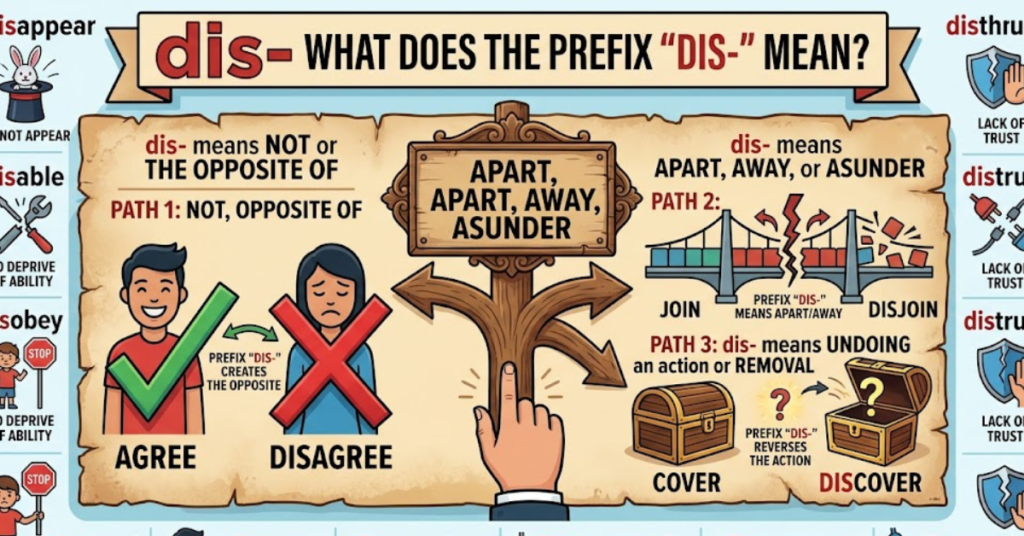
The prefix “dis” is used in English to show a negative or opposite meaning. It often means:
- not
- opposite of
- remove or reverse
- lack of something
So when you see “dis” at the beginning of a word, it usually changes the meaning into something negative or the reverse of the original word.
Simple Meaning
what does the prefix dis mean = it changes a word to its opposite or gives it a negative meaning.
What Does the Prefix Dis Mean? KS2 Explanation
For KS2 learners, it’s helpful to think of “dis” as a word helper that changes meaning.
Here’s the easiest way to understand it:
- “like” means to enjoy something
- “dislike” means not to enjoy it
So “dis” helps turn a positive idea into a negative one.
KS2 Examples
- agree → disagree
- appear → disappear
- connect → disconnect
This shows how the prefix changes the meaning completely.
What Does the Prefix Dis Mean for Kids?
For kids, the idea is even simpler: “dis” means “not” or “the opposite.”
Think of it like flipping a switch:
- happy → unhappy (similar idea, different prefix)
- honest → dishonest
- respect → disrespect
So when children learn what does the prefix dis mean for kids, they can quickly guess the meaning of new words just by spotting the prefix.
How the Prefix “Dis” Changes Words
The prefix “dis” can change words in different ways depending on the base word.
1. Making Something Negative
- dislike = not like
- disagree = not agree
2. Showing Removal or Reversal
- disconnect = remove connection
- disinfect = remove germs
3. Showing Absence
- disappear = not appear
- dishonest = not honest
Common Words Using “Dis” Prefix
Once you know the pattern, you’ll notice many everyday words using this prefix:
- disagree
- disapprove
- disconnect
- discomfort
- disadvantage
- dishonest
- disobey
- disappear
Each word carries a sense of opposite or negation.
Why the Prefix “Dis” Is Important in English
Understanding prefixes like “dis” helps in several ways:
- improves vocabulary quickly
- helps guess meanings of new words
- boosts reading comprehension
- strengthens spelling skills
- supports exam preparation
When students understand prefixes, they don’t need to memorize every single word—they can decode meanings logically.
Word Breakdown: How “Dis” Works in Sentences
Let’s look at how this prefix changes meaning in real sentences.
Without Prefix
- I agree with you.
With Prefix
- I disagree with you.
Another example:
- The phone is connected.
- The phone is disconnected.
This simple change completely flips the meaning.
Common Prefix Mistakes
Sometimes learners confuse “dis” words or misuse them.
Incorrect Examples
- I dislike agree with you.
- The door is disopen.
Correct Examples
- I disagree with you.
- The door is open.
The key is remembering that “dis” must attach to a proper root word.
What Does the Prefix Dis Mean in Simple Terms?
To put it simply, what does the prefix dis mean? It means “not,” “opposite,” or “reverse of something.” It is one of the most common prefixes in English and appears in many everyday words.
Easy Memory Trick for “Dis”
Here’s a simple trick to remember it:
Think:
- “dis” = “do the opposite”
So:
- agree → disagree
- appear → disappear
Just imagine pressing an “undo” button on a word.
Why Kids Should Learn Prefixes Like “Dis”
For young learners, prefixes are a powerful tool because they:
- make reading easier
- improve spelling confidence
- help with school exams (especially KS2 English)
- make vocabulary learning faster
When children understand patterns, English becomes less about memorization and more about logic.
Quick Summary
Here’s a simple recap:
- “dis” is a prefix
- it means not, opposite, or reverse
- it changes word meanings
- it helps build vocabulary
So once you understand it, you can decode many new words easily.
FAQs
What does the prefix dis mean?
It means “not,” “opposite,” or “reverse of something.”
What does the prefix dis mean KS2 level?
At KS2 level, it means the opposite of a word, like “dislike” means not like.
What does the prefix dis mean for kids?
It helps children understand that the word means the opposite or something negative.
Can “dis” change any word?
No, it only works with certain words that can logically form opposites.
Is “dis” always negative?
Mostly yes, but it can also mean reversal or removal depending on the word.
What are common words with “dis”?
Disagree, disappear, disconnect, dishonest, and disobey are common examples.
How can I remember the prefix “dis” easily?
Think of it as an “undo” button that reverses meaning.
Conclusion
Understanding what does the prefix dis mean makes English vocabulary much easier to learn and remember. Instead of memorizing hundreds of words, you can recognize patterns and figure out meanings on your own.
Whether you’re a student learning KS2 English, a beginner building vocabulary, or just someone improving grammar skills, mastering prefixes like “dis” gives you a strong foundation in language.
Once you start spotting it in everyday words, you’ll realize just how often it appears—and how useful it really is.