
English can be tricky, especially when verbs change spelling in different tenses or forms. One common question people ask is whether the correct phrase is “flies away” or “flys away.” If you’ve ever paused while writing this phrase, you’re definitely not alone.
The short answer is simple: “flies away” is correct, while “flys away” is usually incorrect in standard English grammar.
But why does the spelling change? And when, if ever, is “flys” acceptable? In this guide, you’ll learn the grammar rule behind the phrase, see real examples, understand common mistakes, and discover easy tricks to remember the correct version.
What Does “Flies Away” Mean?
The phrase “flies away” means that someone or something moves through the air and leaves a place.
For example:
- The bird flies away when it hears a loud noise.
- Her worries seem to fly away after a vacation.
- A balloon flies away in the wind.
In each sentence, the subject is moving away through the air or disappearing figuratively.
Is “Flys Away” Ever Correct?
In most everyday writing, “flys away” is incorrect.
The confusion happens because many English verbs simply add “-s” in the third-person singular form:
- run → runs
- jump → jumps
- talk → talks
However, verbs ending in a consonant + “y” follow a different rule.
The Grammar Rule
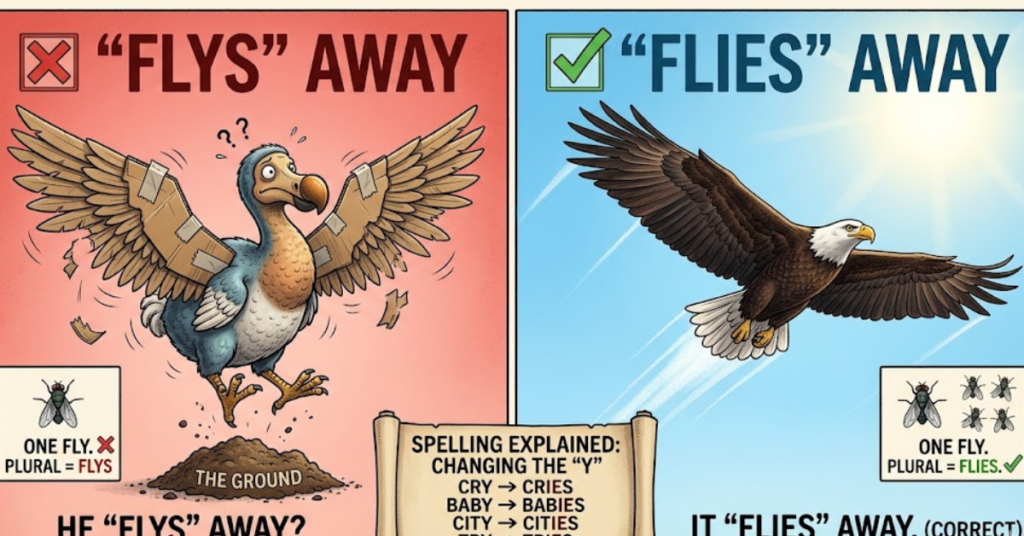
When a verb ends with a consonant followed by “y,” you usually change the “y” to “ies” before adding the ending.
Here’s the pattern:
- fly → flies
- cry → cries
- try → tries
So the correct form becomes:
- He flies away.
- She flies away.
- The bird flies away.
Not “flys away.”
Why People Get Confused
English spelling rules are not always consistent, and pronunciation can make things harder.
The word “flys” looks reasonable because:
- The base word is “fly”
- Many verbs only need an “s”
- Spoken English doesn’t strongly emphasize the spelling difference
Autocorrect and fast typing can also lead to mistakes online, especially in casual posts or comments.
Examples of Correct Usage
Seeing the phrase in context makes the rule easier to remember.
Everyday Examples
- The butterfly flies away before I can catch it.
- Dust flies away when the wind blows.
- He flies away to another city every month for work.
Figurative Examples
The phrase can also be used metaphorically.
- Time flies away when you’re having fun.
- Her stress flies away after meditation.
- Opportunity flies away quickly if ignored.
Common Grammar Mistakes Related to “Fly”
People often make similar errors with other forms of the word “fly.” Here are some examples to watch for.
Incorrect:
- He fly away every morning.
- The bird flys away suddenly.
Correct:
- He flies away every morning.
- The bird flies away suddenly.
Another common mistake involves past tense forms.
Correct Past Tense:
- flew away
Example:
- The kite flew away during the storm.
Easy Trick to Remember the Correct Spelling
A simple memory trick can help.
If a verb ends in:
- consonant + y
Change:
- y → ies
So:
- fly → flies
Think about similar words:
- cry → cries
- reply → replies
- carry → carries
This pattern appears throughout English grammar.
The Difference Between “Fly,” “Flies,” and “Flying”
Understanding the different forms of the verb makes writing much easier.
Fly
Base form of the verb.
Example:
- Birds fly south in winter.
Flies
Third-person singular present tense.
Example:
- The plane flies away at dawn.
Flying
Present participle or continuous form.
Example:
- The kite is flying away.
Can “Flys” Be a Real Word?
Interestingly, “flys” can appear in specialized contexts, but not as the normal verb form of “fly.”
For example:
- “Flys” may appear as a surname.
- Some older or niche references may use alternative spellings.
- Certain technical or branded terms might include it intentionally.
Still, in standard grammar and modern writing, “flies away” is the correct phrase.
Why Correct Grammar Matters
Small spelling errors can affect how professional your writing looks. Whether you’re writing:
- school assignments
- blog posts
- social media captions
- emails
- business content
using correct grammar improves clarity and credibility.
Search engines and AI-powered tools also favor content with proper language usage, which makes accuracy even more important online.
Quick Recap
Here’s the simplest way to remember it:
- “Flies away” = correct
- “Flys away” = incorrect in normal English usage
The spelling changes because verbs ending in consonant + y typically become “ies” in third-person singular form.
FAQs
Is it “flies away” or “flys away”?
“Flies away” is the correct phrase in standard English grammar.
Why does “fly” become “flies”?
Because verbs ending with a consonant + “y” usually change the “y” to “ies” when used with he, she, or it.
Is “flys” a dictionary word?
It can exist in rare or specialized uses, but it is not the correct present-tense verb form in everyday English.
What is the past tense of “fly away”?
The correct past tense is “flew away.”
Example:
- The bird flew away yesterday.
How do I avoid this grammar mistake?
Remember this rule:
- consonant + y = change to “ies”
So:
- fly → flies
- cry → cries
- try → tries
Conclusion
If you’ve been wondering whether to write “flies away” or “flys away,” the answer is clear: “flies away” is the grammatically correct form. The confusion comes from common English spelling patterns, but once you understand the rule, it becomes much easier to remember.
Mastering small grammar details like this can make your writing sharper, clearer, and more professional. If you enjoy learning about tricky English words and confusing grammar rules, exploring similar language guides can help you become a more confident writer every day.