
English grammar is full of tiny details that can make a big difference in writing. One common question people ask is: should it be “in-person” or “in person”? At first glance, both versions seem correct, which is exactly why so many writers get confused.
The truth is that both forms are correct, but they’re used differently depending on the sentence structure. Understanding the difference can instantly improve your writing, especially in professional emails, business communication, interviews, and meeting schedules.
If you’ve ever wondered “is it in-person or in person,” this guide will explain everything in a simple, practical way.
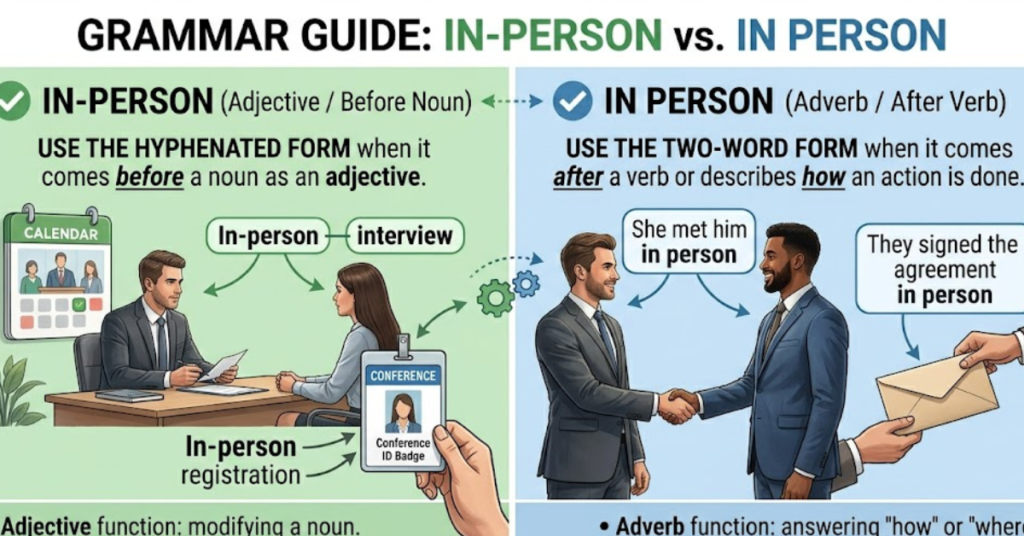
The Main Difference Between “In-Person” and “In Person”
The difference comes down to grammar and how the phrase functions in a sentence.
- “In person” is a phrase used as an adverb.
- “In-person” is a compound adjective that describes a noun.
That’s the basic rule, but let’s break it down with real examples.
When to Use “In Person”
Use “in person” when the phrase describes how something happens. In this case, there is no hyphen.
Examples of “In Person”
- I met the manager in person.
- We discussed the issue in person yesterday.
- She prefers speaking in person instead of texting.
In these examples, the phrase explains the manner of the action.
A quick trick:
If you can replace the phrase with “face-to-face,” you usually do not need a hyphen.
When to Use “In-Person”
Use “in-person” with a hyphen when it directly describes a noun.
Examples of “In-Person”
- We scheduled an in-person interview.
- The company held an in-person meeting.
- Students attended an in-person training session.
Here, the hyphen connects the words because together they act as an adjective before the noun.
Is It In-Person or In Person in Meetings?
Many people search for “in-person or in person meeting” because workplace communication often creates confusion.
Here’s the correct rule:
- “We had the meeting in person.” → no hyphen
- “We had an in-person meeting.” → hyphen needed
The first describes how the meeting happened. The second describes the type of meeting.
Meet In-Person or In Person?
Another common grammar question is whether you should write “meet in-person or in person.”
The correct version is:
- meet in person
Why? Because the phrase describes the action of meeting rather than modifying a noun.
Correct Examples
- Let’s meet in person tomorrow.
- I would rather talk in person.
- They finally met in person after months online.
Incorrect Examples
- Let’s meet in-person tomorrow.
- We talked in-person.
In those cases, the hyphen is unnecessary.
In-Person or In Person Interview?
Professional communication often includes this phrase, especially in hiring situations.
Correct Usage
- We scheduled an in-person interview.
- The candidate attended the interview in person.
Notice how both forms can appear correctly depending on the sentence.
In-Person or In Person AP Style
If you follow AP Style, the rule remains mostly the same.
According to standard style conventions:
- Hyphenate “in-person” when it functions as a compound modifier before a noun.
- Avoid the hyphen when the phrase stands alone after the verb.
AP Style Examples
- an in-person conference
- an in-person presentation
- the attendees appeared in person
This structure keeps writing clean and easy to read.
Why Hyphens Matter in English Grammar
Hyphens help readers understand which words work together.
Without a hyphen, sentences can sometimes feel unclear or awkward. Compound adjectives are especially important in business writing, journalism, and academic communication.
Here are similar examples:
- full-time employee
- well-known author
- high-speed train
“In-person” follows the same grammatical pattern.
Common Mistakes People Make
Even experienced writers occasionally confuse these forms. Here are some of the most common errors.
Incorrect:
- We held an in person meeting.
- She attended an in-person.
- Let’s talk in-person.
Correct:
- We held an in-person meeting.
- She attended in person.
- Let’s talk in person.
Reading the sentence aloud can often help you hear which version sounds natural.
Inperson or In-Person or In Person?
Some people also ask whether “inperson” as one word is acceptable.
In modern standard English:
- “inperson” is incorrect
- “in person” and “in-person” are correct depending on usage
Always avoid combining the phrase into one word unless it’s part of a brand name or specialized term.
Easy Memory Trick
A simple way to remember the rule is this:
Use a hyphen when the phrase comes before a noun.
Example:
- in-person event
No hyphen when the phrase comes after the verb.
Example:
- attended in person
This small trick works in most situations.
Real-Life Examples You Can Copy
Here are some natural examples for emails, workplace writing, and daily communication.
Business Communication
- The workshop will be conducted in person.
- We are planning an in-person seminar next month.
Academic Settings
- Students returned for in-person classes.
- The professor spoke with students in person.
Everyday Conversation
- I’d rather apologize in person.
- They arranged an in-person meetup.
Why This Grammar Rule Matters
Using the correct form makes your writing more polished and professional. Whether you’re sending emails, writing resumes, preparing reports, or publishing online content, small grammar choices affect readability and credibility.
Search engines and AI-powered writing tools also favor well-structured grammar, especially in professional or educational content.
FAQs
Is it in-person or in person?
Both are correct, but they serve different grammatical purposes.
When should I use “in-person” with a hyphen?
Use the hyphen when the phrase describes a noun.
Example:
- in-person interview
When should I use “in person” without a hyphen?
Use it when describing how an action happens.
Example:
- We spoke in person.
Is “inperson” one word?
No. Standard English does not recognize “inperson” as the correct spelling.
Which form is correct for meetings?
Both can work:
- in-person meeting
- met in person
Is “meet in-person” correct?
No. The correct phrase is “meet in person.”
Does AP style use the hyphen?
Yes, AP style hyphenates “in-person” when it acts as a compound adjective before a noun.
Conclusion
Understanding the difference between “in-person” and “in person” is easier once you know the grammar rule behind it. Use the hyphenated version before a noun, and use the open form when describing an action.
Small punctuation details may seem minor, but they can significantly improve the clarity and professionalism of your writing. Whether you’re preparing business emails, interview invitations, academic documents, or everyday messages, using the correct form helps your communication feel polished and trustworthy.
If you want to sharpen your grammar skills even further, exploring similar word pair guides can help you write with greater confidence and accuracy every day.