
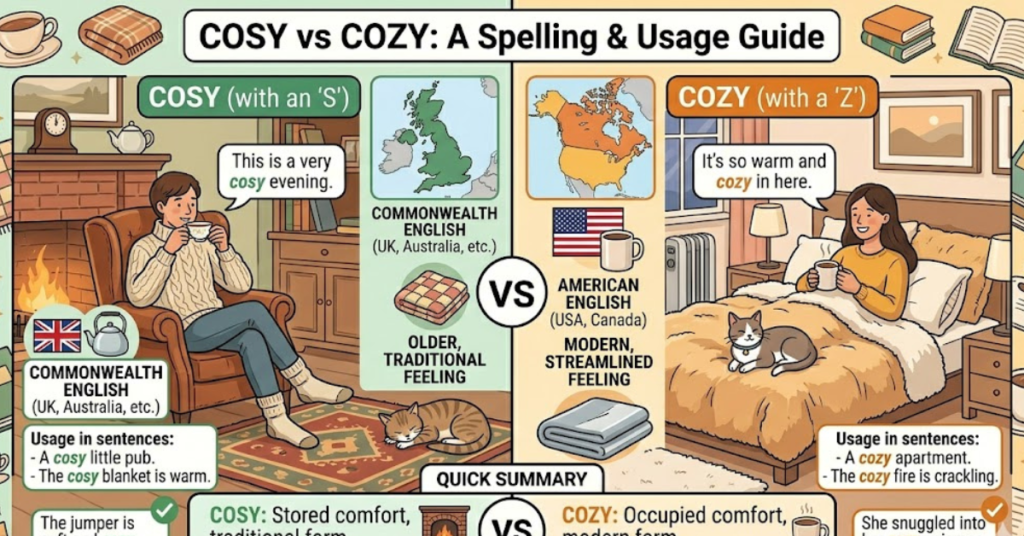

If you’ve ever paused while writing and wondered cosy or cozy, you’re not alone. This small spelling difference often confuses English learners, writers, and even native speakers because both forms appear in books, movies, and everyday conversations.
This guide breaks everything down in a simple way so you can confidently choose the right spelling depending on your audience.
Meaning Explained
Before focusing on spelling, it helps to understand the meaning.
Both “cosy” and “cozy” describe the same feeling:
- Warm and comfortable
- Pleasant and relaxing
- A sense of safety and comfort
Examples
- A cozy room with warm lighting
- A cosy café on a cold day
- A comfortable blanket on the sofa
The meaning never changes—only the spelling does.
Which Spelling Should You Use?
The correct form depends on the type of English you are using.
American English
- Uses: cozy
- Standard in the United States
- Common in global digital content
British English
- Uses: cosy
- Standard in the United Kingdom
- Also common in Ireland, Australia, and New Zealand
So, both versions are correct—just region-specific.UK vs US Usage
United Kingdom
In British English, “cosy” is preferred.
Example:
- A cosy pub in London
United States
In American English, “cozy” is standard.
Example:
- A cozy apartment in New York
Other English Variations
- Australia: Mostly “cosy”
- Canada: Both forms are used, but “cozy” is more common today
- New Zealand: “Cosy” is widely accepted
How to Choose the Right Spelling
A simple rule:
- UK English → cosy
- US English → cozy
The key is consistency. Don’t mix both forms in the same piece of writing.
Correct:
- The room is cosy and warm. (UK style)
- The room is cozy and warm. (US style)
Incorrect:
- The room is cosy and cozy.
Common Synonyms
To avoid repetition in writing, you can also use:
- Warm
- Snug
- Comfortable
- Homely
- Inviting
These words carry a similar feeling without repeating the same term.
“Tea Cosy” or “Tea Cozy”?
This follows the same rule.
- UK English: tea cosy
- US English: tea cozy
It refers to a fabric cover that keeps a teapot warm.
Real-Life Usage Examples
- A cozy bed on a winter night
- A cosy countryside cottage
- A warm and inviting café
- A snug reading corner
The idea is always comfort and warmth.
Why Two Spellings Exist
The difference comes from language history:
- British English preserved older spellings like “cosy”
- American English simplified many spellings over time, including “cozy”
Neither is wrong—they are simply regional variations.
Common Mistakes
- Mixing both spellings in one document
- Assuming one form is universally correct
- Overusing the same word instead of synonyms
- Confusing spelling with pronunciation
FAQs
Is one spelling correct?
Both are correct depending on region.
What does it mean?
It describes something warm, comfortable, and pleasant.
Which is used in the UK?
“Cosy” is standard.
Which is used in the US?
“Cozy” is standard.
Conclusion
The difference between these two spellings is simple: both are correct, but their usage depends on whether you are writing in British or American English.
The meaning stays the same—comfort, warmth, and relaxation—no matter which form you choose. The most important rule is consistency in your writing style