
If you’ve ever paused mid-sentence wondering realize or realise, you’re definitely not alone. This is one of the most common spelling questions in English because both forms appear in books, articles, and online content depending on where the writer is from.
In this guide, we’ll break it down in a simple, practical way so you always know which spelling to use without confusion.
Meaning Explained
Before focusing on spelling, it’s important to understand the meaning.
Both spellings refer to the same idea:
- To become aware of something
- To understand or recognize a fact
- To achieve or accomplish something
Examples
- I didn’t realize how late it was.
- She realised her mistake too late.
- He wants to realize his dream of becoming a doctor.
The meaning never changes—only the spelling differs.
Which Spelling Should You Use?
The correct form depends on English variation.
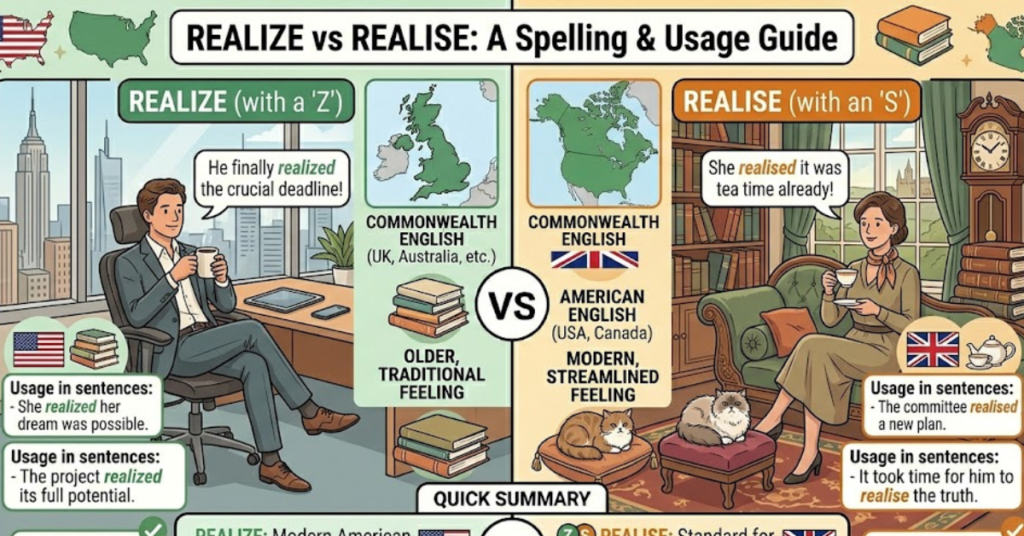
American English
- Uses: realize
- Standard in the United States
- Common in global digital content
British English
- Uses: realise
- Standard in the United Kingdom
- Also used in Ireland, Australia, and New Zealand
So both spellings are correct, just region-specific.
UK vs US Usage
United Kingdom
In British English, “realise” is preferred.
Example:
- I didn’t realise the truth.
United States
In American English, “realize” is standard.
Example:
- I didn’t realize the problem.
What About Canada?
Canadian English is a mix of British and American styles.
- “Realize” is more commonly used in modern Canadian writing
- “Realise” is still accepted, especially in formal or traditional contexts
So both forms exist, but one is more common in everyday usage.
How to Choose the Right Spelling
A simple rule:
- US English → realize
- UK English → realise
The most important thing is consistency. Don’t mix both in the same piece of writing.
Correct:
- She didn’t realize the mistake. (US style)
- She didn’t realise the mistake. (UK style)
Incorrect:
- She didn’t realise and realize the mistake.
Common Mistakes
Many learners get confused because both forms look valid.
Common errors include:
- Mixing both spellings in one document
- Assuming one form is globally incorrect
- Relying entirely on autocorrect
- Using the wrong version for the audience
Easy Memory Trick
Here’s a simple way to remember:
- “Z = USA” → realize
- “S = UK” → realise
This small trick helps you quickly choose the correct spelling.
Usage in Real Life
You’ll see both forms in:
- Academic writing
- Business communication
- Books and journalism
- Online content
The meaning remains the same across all contexts.
FAQs
Is one spelling correct?
Both are correct depending on regional English.
What does it mean?
It means to become aware of something or to achieve something.
Which is used in the UK?
“Realise” is standard.
Which is used in the US?
“Realize” is standard.
Is it different in Canada?
Both are used, but “realize” is more common today.
Conclusion
The difference between these two spellings is simple: both are correct, but usage depends on whether you’re writing in American or British English.
The meaning stays the same—awareness, understanding, or achievement—no matter which form you use. The key is to stay consistent and match your audience.
Once you understand the regional rule, choosing between them becomes effortless.