
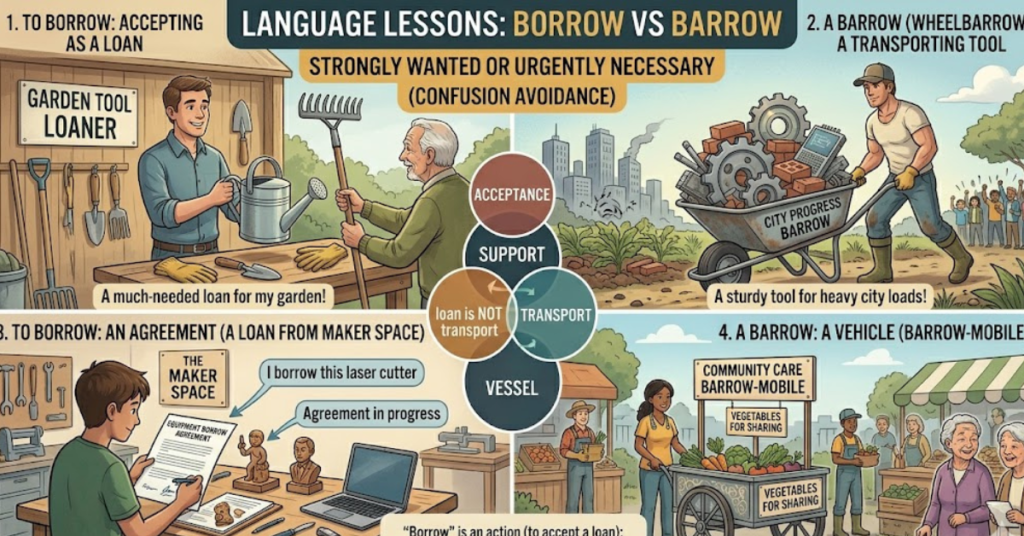

English has plenty of words that sound similar but mean completely different things. One pair that often confuses learners and even native speakers is “borrow” and “barrow.” At first glance, the two words seem almost identical in pronunciation, but their meanings have nothing in common.
Understanding the difference between borrow vs barrow can help improve your writing, speaking, and overall vocabulary. Whether you’re studying English, writing professionally, or simply trying to avoid embarrassing mistakes, learning how to use these words correctly is important.
In this guide, you’ll discover the meanings, pronunciation differences, sentence examples, grammar usage, and simple tricks to remember each word easily.
What Does “Borrow” Mean?
The word “borrow” is a verb. It means to take something from someone temporarily with the intention of returning it later.
Simple Definition
Borrow = to use something that belongs to another person for a limited time.
Examples of “Borrow”
- Can I borrow your pen?
- She borrowed a book from the library.
- We borrowed money to buy a car.
In every example, something is taken temporarily and expected to be returned.
What Does “Barrow” Mean?
“Barrow” is usually a noun, and it has several meanings depending on context.
The most common meaning refers to a wheelbarrow or handcart used for carrying heavy items.
Examples of “Barrow”
- The gardener pushed a barrow full of soil.
- Workers moved bricks using a wheelbarrow.
- The farmer carried vegetables in a barrow.
In British English, “barrow” may also refer to:
- a market cart
- an ancient burial mound
Borrow vs Barrow: Key Difference
The easiest way to separate these words is by remembering their functions.
Borrow
- Action word (verb)
- Related to taking or using temporarily
Barrow
- Object or thing (noun)
- Related to carrying items or historical mounds
Even though they sound similar in some accents, they belong to completely different categories of meaning.
Pronunciation Differences
Depending on regional accents, these words may sound very close.
Borrow
Typically pronounced:
- BOR-oh
Barrow
Typically pronounced:
- BARR-oh
In fast speech, the distinction can become subtle, which explains why learners sometimes confuse them.
Common Mistakes People Make
Many spelling mistakes happen because people type words based on sound rather than meaning.
Incorrect:
- Can I barrow your phone?
- She borrowed money from her friend.
Correct:
- Can I borrow your phone?
- She borrowed money from her friend.
The confusion usually comes from pronunciation rather than grammar knowledge.
How to Remember the Difference
A simple memory trick can help.
Borrow = Temporary Use
Think:
- borrow = bring back
Both words start with “b,” reminding you that borrowed items should be returned.
Barrow = Carrying Tool
Think about:
- wheelbarrow
- pushing dirt or stones
A barrow carries physical objects rather than borrowing them.
Examples in Everyday Conversation
Learning words through real-life examples makes them easier to remember.
Sentences Using “Borrow”
- I need to borrow a charger.
- He borrowed my jacket for the trip.
- Students often borrow notes before exams.
Sentences Using “Barrow”
- The construction worker filled the barrow with cement.
- She pushed the garden barrow across the yard.
- The vendor stored fruit in a wooden barrow.
Borrow in Grammar and Sentence Structure
Since “borrow” is a verb, it changes form depending on tense.
Present Tense
- borrow
- borrows
Example:
- She borrows books every week.
Past Tense
- borrowed
Example:
- He borrowed my laptop yesterday.
Present Participle
- borrowing
Example:
- They are borrowing equipment for the event.
Different Meanings of “Barrow”
Although wheelbarrows are the most familiar meaning, the word has historical and regional uses too.
Burial Mound
In archaeology and history, a “barrow” can mean an ancient burial hill.
Example:
- The hikers explored an old burial barrow.
Market Cart
In some British contexts, a barrow refers to a street vendor’s cart.
Example:
- The fruit seller arranged apples on his barrow.
Why These Words Matter in Writing
Using the wrong word can completely change the meaning of a sentence.
For example:
- “Can I barrow your book?” sounds incorrect and confusing.
- “Can I borrow your book?” is clear and grammatically correct.
Accurate vocabulary improves:
- professional writing
- academic communication
- spoken English
- confidence in conversations
Similar Confusing Word Pairs
If you struggle with borrow and barrow, you may also confuse similar-sounding English words like:
- brake vs break
- weather vs whether
- accept vs except
- affect vs effect
English contains many homophones and near-homophones, so confusion is completely normal.
Quick Recap
Here’s the easiest way to remember the difference:
Borrow
- verb
- temporary use
- must usually be returned
Barrow
- noun
- carrying cart or mound
- physical object
Once you connect each word with its purpose, the confusion becomes much easier to avoid.
FAQs
What is the difference between borrow and barrow?
“Borrow” means to take something temporarily, while “barrow” refers to a cart, wheelbarrow, or burial mound.
Is “barrow” ever used as a verb?
Rarely. In modern English, it is most commonly used as a noun.
Why do people confuse borrow and barrow?
The words sound similar in pronunciation, especially in certain accents.
What is the correct spelling for taking something temporarily?
The correct word is “borrow.”
What is a wheelbarrow?
A wheelbarrow is a small cart with one wheel used to transport materials like soil, bricks, or tools.
Is “Can I barrow your pen?” correct?
No. The correct sentence is:
- “Can I borrow your pen?”
What does “burial barrow” mean?
It refers to an ancient mound of earth used as a burial site in historical cultures.
Conclusion
Understanding the difference between borrow vs barrow is easier once you learn the meaning and function of each word. “Borrow” relates to temporarily taking something, while “barrow” refers to a physical cart or historical mound.
Although the words may sound alike, their meanings are completely different. Using the correct word improves clarity, professionalism, and confidence in both writing and conversation.
If you enjoy learning about commonly confused English words, exploring similar grammar and vocabulary guides can help strengthen your communication skills and make everyday English much easier to master.