
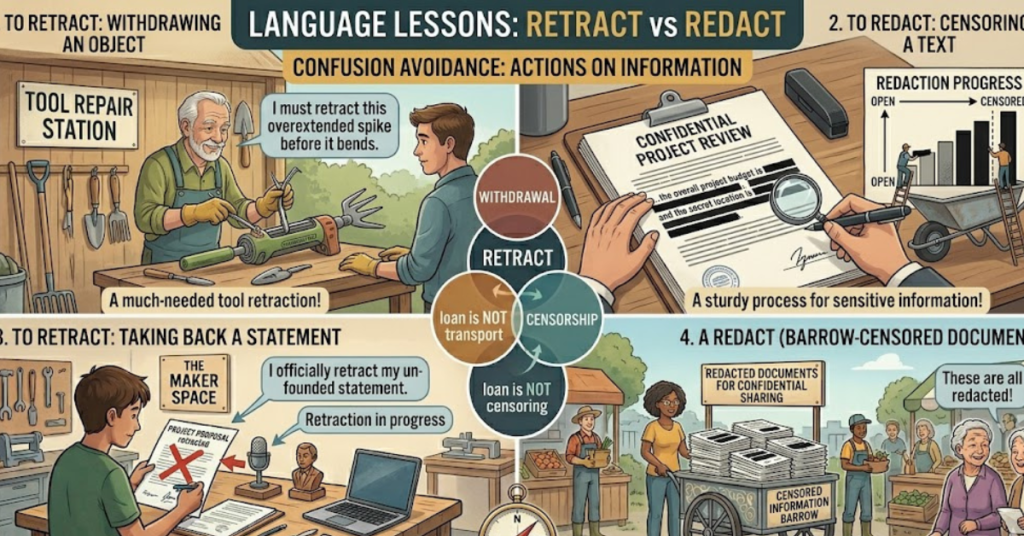

Some English words look and sound so similar that people mix them up all the time. “Retract” and “redact” are perfect examples. They share similar spelling, both appear in professional writing, and both involve removing something in some way. But despite those similarities, their meanings are completely different.
Understanding retract vs redact is important for clear communication, especially in legal writing, journalism, publishing, business communication, and everyday English. Using the wrong word can completely change the meaning of a sentence.
In this guide, you’ll learn the exact definitions, grammar usage, real-world examples, and easy memory tricks that make these commonly confused words simple to understand.
Retract vs Redact Meaning
The easiest way to understand these words is to focus on what is being removed.
- “Retract” means to take back a statement, claim, or action.
- “Redact” means to hide, censor, or edit sensitive information from a document.
Although both involve removal, the purpose behind each word is very different.
What Does “Retract” Mean?
“Retract” is a verb that means to withdraw or take back something previously said, written, or stated.
People usually retract:
- statements
- accusations
- opinions
- announcements
- published claims
Examples of “Retract”
- The newspaper retracted the false story.
- He retracted his comment after learning the truth.
- The company had to retract the statement.
In each example, something spoken or written is officially taken back.
What Does “Redact” Mean?
“Redact” is also a verb, but it refers to editing or removing confidential information from a document before publication or release.
This is especially common in:
- legal documents
- government files
- police reports
- contracts
- medical records
Examples of “Redact”
- The lawyer redacted personal information from the report.
- Names were redacted for privacy reasons.
- The agency released a heavily redacted document.
Instead of taking back information entirely, redaction hides specific parts.
The Main Difference Between Retract and Redact
The key difference comes down to intent.
Retract
- Take back information completely
- Often related to statements or claims
- Common in media and communication
Redact
- Hide selected information
- Usually related to documents
- Common in legal and official settings
One removes the statement itself, while the other removes parts of the content.
Why People Confuse These Words
There are several reasons why these words are often mixed up.
Similar Spelling
Both words:
- start with “re”
- end with “act”
- have similar pronunciation patterns
Similar Contexts
They often appear in:
- journalism
- legal writing
- official communication
Similar Idea of Removal
Both involve removing something, which creates additional confusion.
Real-Life Examples of “Retract”
Seeing natural examples makes the meaning easier to remember.
Media and Journalism
- The magazine retracted the article after criticism.
- The reporter later retracted the accusation.
Personal Communication
- She quickly retracted her harsh words.
- I retract what I said earlier.
Business Situations
- The company retracted its original announcement.
- Officials retracted the inaccurate figures.
Real-Life Examples of “Redact”
“Redact” is especially common in professional and legal contexts.
Legal Examples
- The court ordered lawyers to redact private details.
- Sensitive evidence was redacted before release.
Government Documents
- The agency redacted names from the public report.
- Several pages were partially redacted.
Workplace Examples
- HR redacted employee addresses from the file.
- Financial records were redacted for confidentiality.
Grammar and Word Forms
Understanding how each word changes in sentences can improve your writing.
Forms of “Retract”
- retract
- retracts
- retracted
- retracting
Example:
- The author is retracting the statement.
Forms of “Redact”
- redact
- redacts
- redacted
- redacting
Example:
- Officials are redacting classified details.
Easy Memory Tricks
Simple memory tricks can help you avoid confusion permanently.
Retract = Take Back
Think:
- retract = reverse a statement
The word relates to undoing or withdrawing something already said.
Redact = Remove Details
Think:
- redact = dark black marker over text
Many people associate redaction with blacked-out documents, which makes the meaning easier to remember.
Common Mistakes to Avoid
People sometimes accidentally swap the two words in writing.
Incorrect:
- The company redacted its apology.
- The lawyer retracted private information from the file.
Correct:
- The company retracted its apology.
- The lawyer redacted private information from the file.
Using the wrong term can make professional writing sound inaccurate or confusing.
When to Use “Retract”
Use “retract” when:
- withdrawing a claim
- correcting misinformation
- taking back a statement
- reversing an opinion
Examples
- retract an accusation
- retract a statement
- retract a confession
When to Use “Redact”
Use “redact” when:
- hiding sensitive information
- censoring documents
- protecting privacy
- editing confidential content
Examples
- redact names
- redact addresses
- redact classified information
Why Word Choice Matters
Precision in language matters, especially in professional environments. Legal, academic, and journalistic writing rely heavily on exact wording.
Using “retract” instead of “redact,” or vice versa, can:
- confuse readers
- weaken credibility
- change the meaning of a sentence
- create professional misunderstandings
Clear vocabulary improves both written and spoken communication.
Similar Confusing Word Pairs
If you confuse these words, you may also struggle with:
- affect vs effect
- imply vs infer
- accept vs except
- insure vs ensure
- adapt vs adopt
English contains many similar-looking terms with completely different meanings.
Quick Recap
Here’s the simplest way to remember the difference:
Retract
- take back a statement
- withdraw information completely
Redact
- hide parts of a document
- remove sensitive details selectively
That one distinction usually clears up the confusion immediately.
FAQs
What is the difference between retract and redact?
“Retract” means to take back a statement, while “redact” means to remove or hide sensitive information from a document.
Is redact used in legal documents?
Yes. Lawyers and government agencies often redact confidential information before releasing files publicly.
What does retract mean in journalism?
It means officially withdrawing a previously published statement or report.
Can a document be retracted?
Yes, although “retract” is more commonly used for statements, articles, or claims.
What does a redacted document look like?
It usually contains hidden or blacked-out sections where sensitive information was removed.
Why do people confuse retract and redact?
The words look and sound similar, and both involve removing something.
Which word relates to privacy?
“Redact” is the word associated with privacy and confidential information.
Conclusion
Understanding retract vs redact becomes much easier once you focus on what is being removed. “Retract” means taking back a statement or claim, while “redact” means hiding sensitive details within a document.
Although the words look alike, they serve very different purposes in communication. Using the correct one improves clarity, professionalism, and confidence in your writing.
If you enjoy learning about commonly confused English words, exploring more grammar and vocabulary guides can help sharpen your communication skills and make your writing far more precise and effective.